
Learning objective three for this course is to ‘show a developed critical understanding of contemporary practice in relation to historical practice and theory, and the themes explored in this unit’.
When trying to find a post that illustated this I felt I did not have any that looked at how current practioners of portrait photography link their work to historical practice and so I searched for photographers whose work is informed by historical practice and came across photographs produced by Hendrik Kerstens.
Kerstens (1956 -) is a Dutch photographer who at the age of forty decided to leave his business career and pursue a more creative profession (Hendrik Kerstens, s.d.). With his wife Anna working full time to support his change of direction, Kerstens studied photography whilst also caring for his young daughter, Paula (Hendrik Kerstens, s.d.). Kirsten’s inital photographs of his daughter were family snap shots, a desire to capture fleeting moments of childhood (Hendrik Kerstens – Artists – Danziger Gallery, s.d.). However, as Paula grew Kerstens sought a way to express her physical and psychological changes which resulted in him photographing her in the style of the 17th century Dutch masters. Kersten described the event that prompted him to start photographing her in that style:
“One day Paula came back from horseback riding. She took off her cap and I was struck by the image of her hair held together by a hair-net. It reminded me of the portraits by the Dutch masters and I portrayed her in that fashion. After that I started to do more portraits in which I refer to the paintings of that era. The thing that fascinates me in particular is the way a seventeenth-century painting is seen as a surface which can be read as a description of everyday life as opposed to the paintings of the Italian renaissance, which usually tell a story. Northern European painting relies much more on craftsmanship and the perfect rendition of the subject. The use of light is instrumental in this.”
Hendrik Kerstens
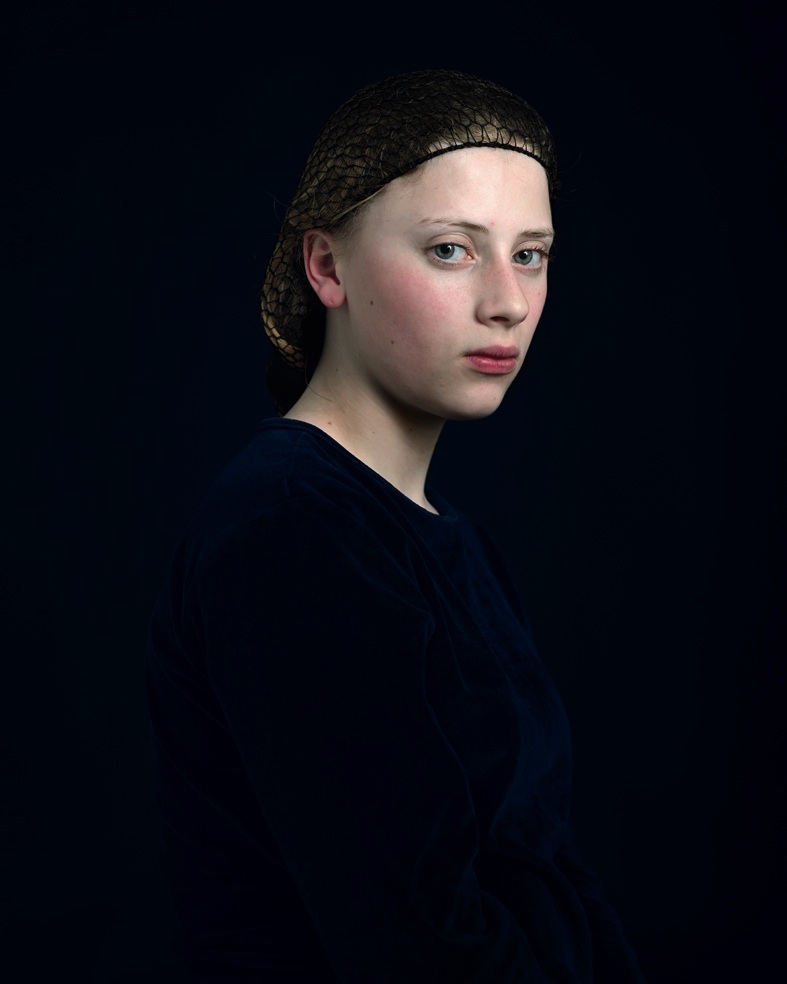
From Hairnet in 2000, Kerstens continued to photograph Paula in a manner that evoked the Dutch masters, however he did not use this style exclusively, photographing Paula in a hoodie, a baseball cap and with earphones listening to an ipod. Kersten did not just want to imitate Dutch painting from the 17th century and over time the series developed as an amusing and conceptual dialogue between the past and the present (Hess, s.d.). Kerstens reinforced his point about the Northern European paintings showing everyday life by using household objects to create headdresses that mimic those seen in paintings for the 17th century. Whilst the headwear, which included aluminium foil and a plastic bag, is distinctly modern, the pose, lighting and facial expression all combine to give the work its distincitve Dutch golden age feel.
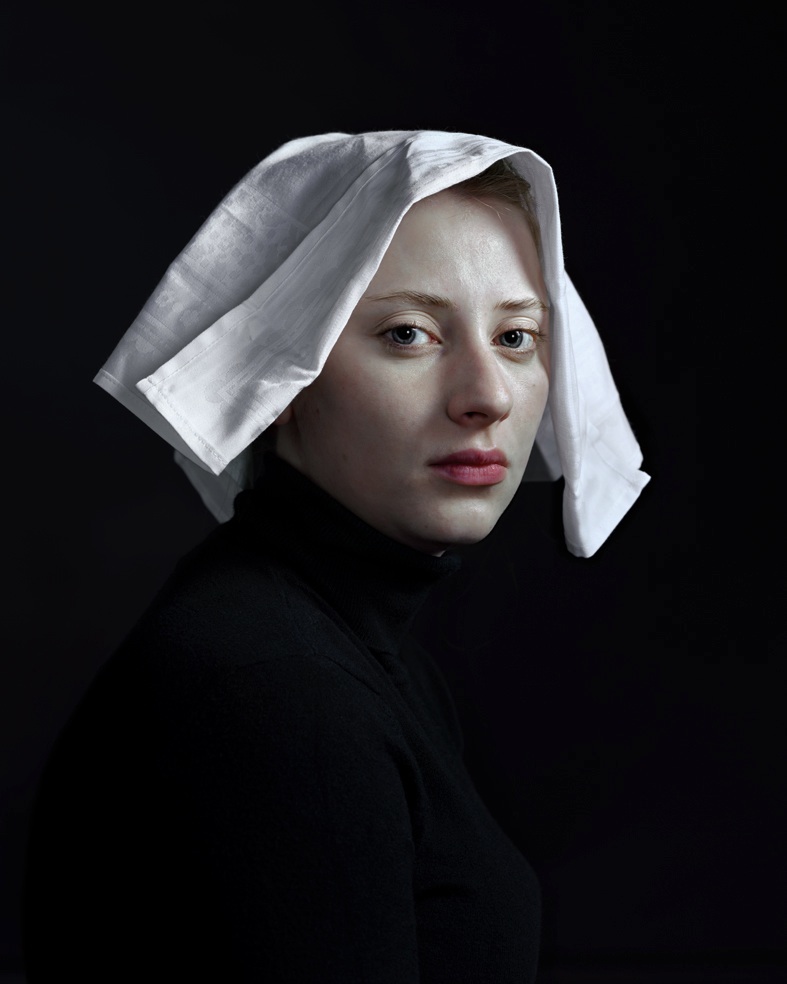
Although Kerstens work is shot in a style reminiscent of the Dutch masters, referencing Johannes Vermeer, Frans Haals and Jan van Eyck, in photographic terms Kerstens work can be considered similar to that of Sally Mann. From the early documentary portraits, including one of Paula with a broken arm which echos Sally Mann’s Damaged Child (Fuller, 2018), the work records the development of Paula and charts the journey from child through adolesence and into adulthood. However, unlike Mann’s work, Kersten’s work is not an exploration of carefree youth, instead it seems to be an alltogether more serious undertaking.
As well as documenting her journey from childhood to adulthood, Kersten’s work also sees a change in Paula’s participation in the images. As Kersten stated “First we started with documentary photography, then Paula transformed from object to subject. Now we work together as a duo.” (Kersten, s.d. cited in Fuller, 2018). As Paula’s participation in creating the images increased her presence in the images becomes more assured and assertive and the work has fewer associations to Mann’s but instead has more in common with Cindy Sherman’s history portraits and Zanele Muholi’s series, Somnyama Ngonyama (Hail the Dark Lioness): powerful self-portraits that rewrite the narrative of female objectification.(Fuller, 2018)
I find Dutch art from the 17th century fascinating, the move away from painting being commissioned by the church and being primarily religious in nature and instead to being much more documentary, recording people and events from their lives; so it is not surprising that I like Kersten’s work. What I like about it is the simplicity, the stillness and the calmness combined with the wit and irreverence. I think the work shows an obvious influence of historical practice and also references to contemporary photographers. What I also like about the work, and which also fits in with my feelings following submission of assignment five, is that despite all the images of her, Paula remains enigmatic. Over the period of over twenty years she has succeeded in revealing almost nothing about herself, save for a willingness to be photographed wearing strange headwear.
Fuller, G. (2018) This Photographer Is a Modern Day Dutch Master. At: https://www.elledecor.com/life-culture/a23743263/photographer-hendrik-kerstens-dutch-master/ (Accessed 23/08/2020).
Hendrik Kerstens (2020) In: Wikipedia. At: https://en.wikipedia.org/w/index.php?title=Hendrik_Kerstens&oldid=964096955 (Accessed 23/08/2020).
Hess, Hugo (s.d.) Hendrik Kerstens | Widewalls. At: https://www.widewalls.ch/artists/hendrik-kerstens (Accessed 24/08/2020).
Hendrik Kerstens (s.d.) At: http://hendrikkerstens.com/ (Accessed 23/08/2020).
Hendrik Kerstens – Artists – Danziger Gallery (s.d.) At: https://www.danzigergallery.com/artists/hendrik-kerstens2 (Accessed 23/08/2020).
 OCA517401I&P