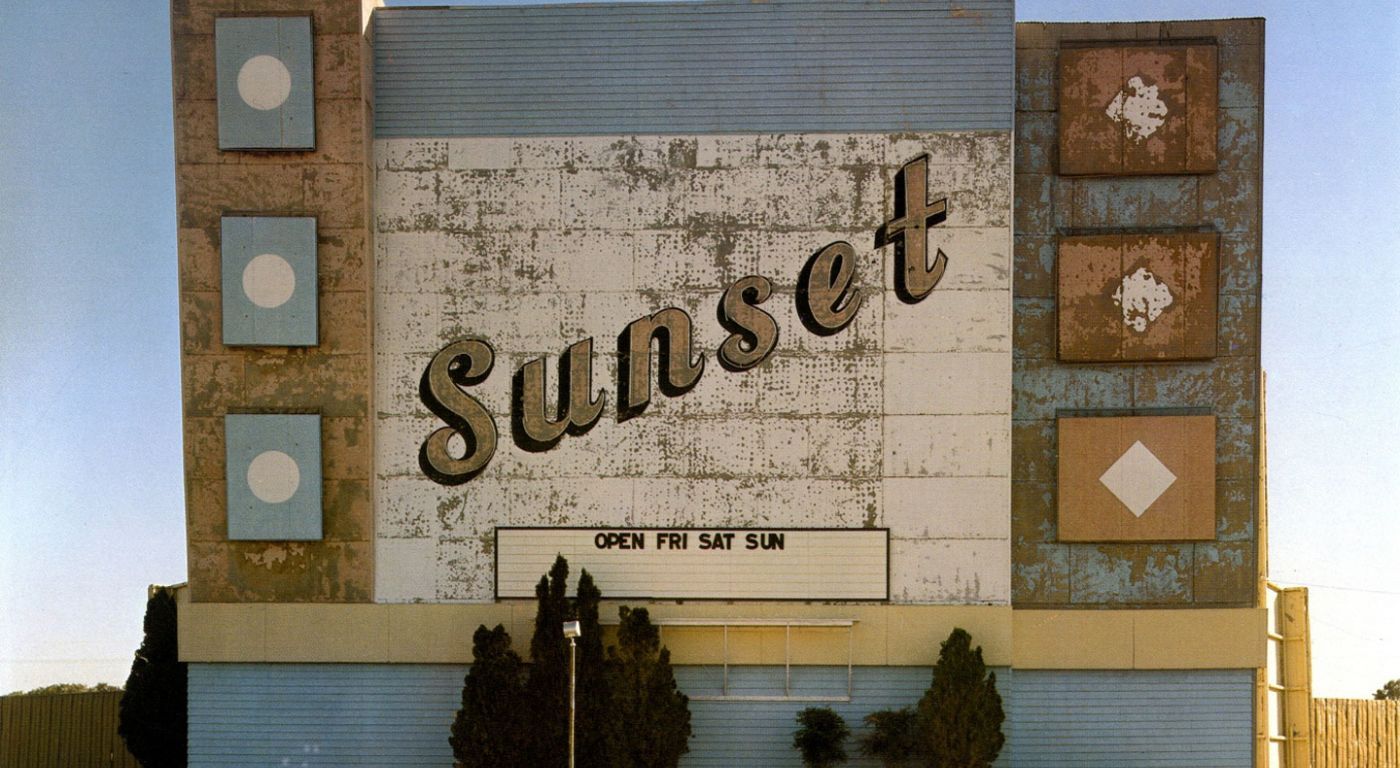
Stephen Shore (1947 – ) is an American photograph who along with William Egglestone and Joel Meyerowitz were pioneers in the development of colour fine art photography in the late 1960s and early 1970s.
Shore’s photographic career started at an early age and when he was fourteen he contacted Edward Steichen, the director of MoMA’s Department of Photography in order to show Steichen his work. As Shore recalled when interviewed for by Aaron Schuman in 2004:
I think I didn’t know any better. I didn’t know that you weren’t supposed to do this. So I just called him up and said, ‘I’d like to show you my work.’…He bought three!
Stephen Shore (‘Uncommon Places’, An Interview with Stephen Shore, 2004)
In 1965 Shore met Andy Warhol who offered him an open invitation to his studio, the Factory and over the next two years Shore would document the artist’s studio during its most innovative years. In 1971 at the age of twenty-four, Shore was given a solo exhibition at the New Yorks’ Metropolitan Museaum of Art, the first time a living photographer had had a solo show (ASX, 2010).
In 1972 Shore and friend set out to drive from New York to Amarillo, Texas. Shore had little experience of the US outside of New York and as he was the passenger he was observe this unfamiliar landscape during the 1,700 mile drive. Later that year Shore set out alone to photograph the world he had seen through the car window and sought to record what he saw in the manner of a tourist. He shot using 35mm colour film and when he had finished his journey he returned to New York with hundreds of rolls of film which he sent off to Kodak for them to be developed and printed.(ASX, 2010)
The work, Amrican Surfaces, was exhibited at the Light Gallery in New York, however, the work received poor reviews and even John Swarkowski, Steichen’s succesor at MoMA, was sceptical about it. American Surfaces was in effect a rejection of the Cartier-Bresson idea of the decisive moment. Instead of trying to capture a moment of change or motion, Shore had sought to capture post-war American following a decade of considerable social change inthe 1960s, as it was experienced everyday by its citizens.
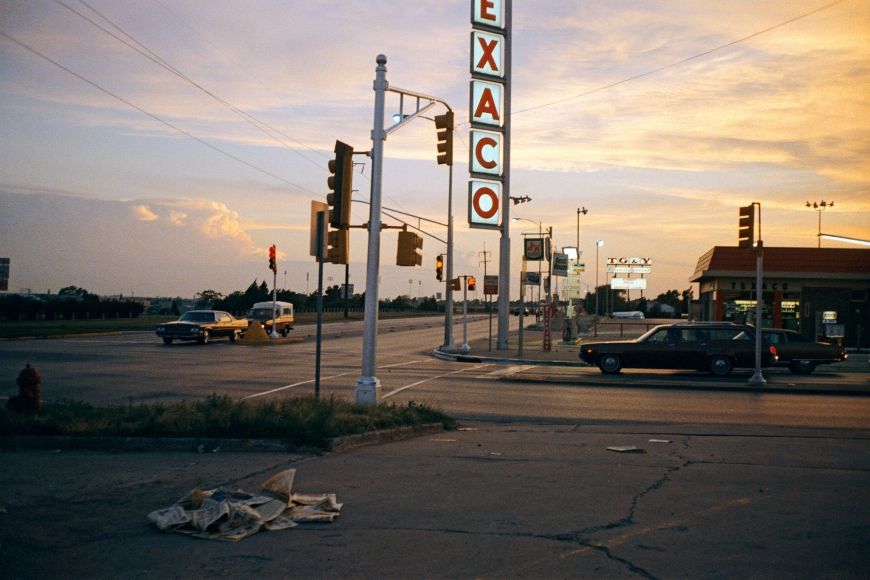
Although American Surfaces included shots of the interior of motels, meals, portraits and urban landscapes, it is images such as Oaklahoma City, Oaklahoma, 1972 that give a clue to Shore’s next work, Uncommon Places. The image has multiple focal points, instead of a more traditional single focal point and unusual framing, cutting through the Texaco sign. The image rejects the traditional ideas of documentary photography and references Ed Ruscha’s 1963 book Twentysix Gasoline Stations. Shore saw Ruscha’s work as opening up the possibility of photography as a record, rather than as an elevation of the beautiful, and this image’s rejection of romantic rules suggests Shore actively endeavored to adopt this concept and explore its possibilities. In the interview below recorded in New York in 2011, Shore speaks both about American Surfaces but also about photographing Andy Warhol and him working at the Factory.
Undaunted by the reaction to American Surfaces Shore went on to refine his work. He perceived that part of the reason the work was not positively received was due to the size of the prints, despite the Kodak produced prints being an element of his artistic intention. Shore thought that by hand-printing larger images the work would be viewed more positively, however, he soon realised that the 35mm negatives were just not big enough to produce the size and quality of prints he wanted (ASX, 2010).
In order to produce negatives that would be large enough to enable him to make prints in the sizes he wanted, Shore initially switched to photographing using a 4′ x 5′ press camera and not long afterwards changed again, this time to an 8′ x 10′ view camera. Between 1973 and 1981, Shore used large format cameras to produce the images that would be published in 1982 as Uncommon Places. The change of camera, and particularly the change to using an 8′ x 10′ view camera, changed the way Shore worked and produced images. Due to moving frmo 35mm to large format cameras, Shore no longer shot hand-held images and instead used a tripod. This more static approach combined with the ability to see the final image in much greater detail on the ground glass screen of the view camera , combined with the cost of large format negatives meant that Shore’s working method was slower and more contemplative. Shore described how working with a 8′ x 10′ camera changed his approach in an interview with Aaron Schuman in 2004:
And, especially if I’m photographing an intersection, I don’t have to have a single point of emphasis in the picture. It can be complex, because it’s so detailed that the viewer can take time and read it, and look at something here, and look at something there, and they can pay attention to a lot more. So I found myself loving working on a tripod, loving working with an 8×10, and that the pictures changed so it was not simply that I was just doing American Surfaces with an 8×10, but that there were new things developing, that started simply because I was using the 8×10. And that lead to these explorations.
Stephen Shore (‘Uncommon Places’, An Interview with Stephen Shore, 2004)
In the video below from 2012, Shore talks about how moving from a 35mm camera to an 8′ x 10′ view camera altered how he approached image making.
Uncommon Places was published by Aperture in 1982. The original edition contained only forty images but it has subsequently been expanded and reprinted. I think what is interesting about the work is not only the iconic images of small town America in the 1970s and early 80s, but also how changing the camera he used fundamentally altered the way Shore worked and composed his images. I think as a student what this reinforces is the importance of looking and thinking about composition before pressing the shutter release.
Sources
ASX, E. @ (2010) Stephen Shore: ‘Uncommon Places’ (2004). At: https://americansuburbx.com/2010/12/stephen-shore-uncommon-places-2004.html (Accessed 12/07/2020).
Stephen Shore (2020) In: Wikipedia. At: https://en.wikipedia.org/w/index.php?title=Stephen_Shore&oldid=953118509 (Accessed 12/07/2020).
Schuman, A. (2004) ‘Uncommon Places’, An Interview with Stephen Shore. At: http://aaronschuman.com/shoreinterview.html (Accessed 14/07/2020).
Stephen Shore Artworks & Famous Photography (s.d.) At: https://www.theartstory.org/artist/shore-stephen/ (Accessed 14/07/2020).
Stephen Shore Uncommon Places (2011) New York: Spike Productions. At: https://vimeo.com/32562146 (Accessed 14/07/2020).
Stephen Shore American Surfaces (2011) Spike Productions. At: https://vimeo.com/32521780 (Accessed 14/07/2020).
 OCA517401I&P