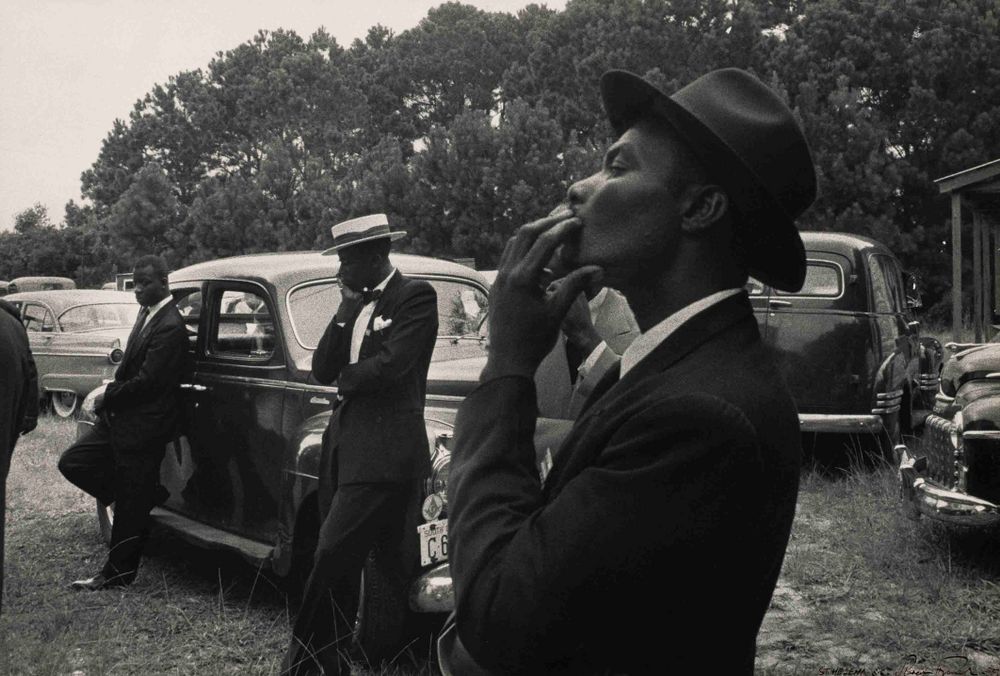
Robert Frank (1924 – 2019) was a Swiss-American photographer most famous for his work The Americans, first published in France in 1958. The second child of a German father and Swiss Mother, Frank lived in Zurich where in 1941 he began an apprentiship with a photographer who lived in the same appartment building as Frank’s family. In 1946 at the end of his training he produced 40 Fotos a hand-bound volume that showed the influences Frank had absorbed during is training which included modernism, reportage, and the Heimat (Homeland) style.
In 1947, frustrated by the contraints of Switzerland, Frank emigrated to the United States and soon after arriving in New York was hired by the legendary Art Director at Harper’s Bazaar, Alexey Brodovitch. Although he found working with Brodovitch inspiring, Frank did not enjoy working at Harper’s, leaving in late 1947 and travelling to South America. During his time in South America he preferred to photograph the people rather than landscape or monuments, later commenting he preferred the present and ‘things that move’. After returning to New York in early 1949, he made another hand-bound book of his photographs which showed the influence not only of Brodovitch, but also Bill Brandt, André Kertész, and Jakob Tuggener. The book was notable for Frank’s use of non-narrative, non-chronological methods of joining his photographs, a technique he would later use in The Americans.
Between 1949 and 1953 Frank travelled between the United States and Europe taking images of subjects that reflected his understanding of peoples and their cultures. However, although he had important champions such as Edward Steichen, director of the department of photography at the Museum of Modern Art, his work was rarely published. With few commercial outlets for his work, Frank continued to make hand-bound photo books including Mary’s Book and Black White and Things. Once again, Frank experimented with new ways of linking his photographs, conceptually, formally, thematically, and emotionally.
Frustrated that his work was not widely published, in the autumn of 1954 Frank applied for a Guggenheim Fellowship ‘to photograph freely throughout the United States,’ and ‘make a broad voluminous picture record of things American.’ as he wrote on his application. With letters of recommendation from Steichen, Brodovitch and the noted photographer Walker Evans, Frank was successful and in the Spring of 1955 Frank began to take the photographs that would later be published in The Americans.
In the summer of 1955, Frank, wife Mary and their two children, Pablo and Andrea set off in a used Ford that Frank had purchased on a nine month journey covering almost 10,000 miles across the United States. In each place he stopped he photographed people going about their everyday lives in ordinary places. After a few more trips in the summer of 1956, most notably to the Democratic National Convention in Chicago, Frank had amassed 767 rolls of film comprising around 27,000 images. From these he printed over one thousand rough 8 x 10 inch prints of images that interested him and from these he selected 83 images.
Frank’s difficult in getting his work published in the United States continued and The Americans was first published in France in 1958 as Les Américains. The following year The Americans was publised in the US by Grove Press and included an introduction by the Beat poet Jack Kerouac. Instead of showing a pristine, wholesome America, the images were of a country plagued by racism, graft and numbed by the increasing culture of consumption. As well as the subject matter, the images themselves which defied photographic conventions of the time, were also unsettling. Initial reaction to the book in United States, where it was perceived as being anti-American, was harsh and sales were poor. A review in Popular Photography at the time derided Frank’s images as ‘meaningless blur, grain, muddy exposures, drunken horizons and general sloppiness.’ The supposed shortcomings of Frank’s images was due to the work being shot using a 35mm camera (Warner Marien, 2014) which enabled him to take pictures discreetly and at speed, giving his images their unpremeditated look. After its inital cool reception, sentiment changed and during the 1960s the book was seen as revolutionary and of presaging many of the changes to society that would take place in that decade.
Shortly after the publication of The Americans Frank abandonded stills photography for film-making and it was not until the early 1970s that he returned to photography. He continued to work in both mediums until his death in 2019 but he never produced another body of work that had the same impact as The Americans.
I must admit that I was underwhelmed when I got hold of a library copy of the book. I think there were two reasons, first the quality of the printing was very poor and detracted from the images and second the techinques that Frank used that caused so much consternation when the work was first publised over sixty years ago did not appear revolutionary. Indeed, what passed for revolutionary in the late 1950s is now just part and parcel of image-making sixty years later. What I did like about the images was the everydayness, the record of the people and a country in a period of massive change, presented through the ordinary routines and rituals of their lives.
What I think is interesting when considering The Americans is to look at the differences in approach between Robert Frank and Harry Callahan when thinking about identity and place. Frank’s work is that of an outsider, a Swiss-American based in New York, he crossed America and chose to photograph other people’s daily lives to make sense of the world around him. Callahan who was working around the same time chose to photograph his world. His approach of taking photographs around where he lived and worked in the morning and processing them in the afternoon indicates a lack of the restlessness that Frank appeared to have. However, despite their differences in approach their work is equally engaging and I think it high-lights the need as a practioner to be authentic. Whilst imitating another artist’s style is part of the learning process, ultimately I think that for work to be successful it needs to be a reflection of the artist’s personality and view on the world.
Sources
Artist Biography: Robert Frank (s.d.) At: https://www.nga.gov/press/backgrounder/bio-robertfrank.html (Accessed 04/07/2020).
Robert Frank Biography, Life & Quotes (s.d.) At: https://www.theartstory.org/artist/frank-robert/ (Accessed 04/07/2020).
Warner Marien, M. (2014) Photography: A Cultural History. (4th ed.) London: Laurence King Publishing.
 OCA517401I&P