
As part of the research for this section we are encouraged to find examples of photographers or artists who create portraits without including the human figure. One of the artist I have come across is Justine Varga, whose work, Maternal Line won the Olive Cotton award, named after the pioneering Austrialian modernist photographer of the 1930s and 40s, Olive Cotton (1911-2003); in 2017.
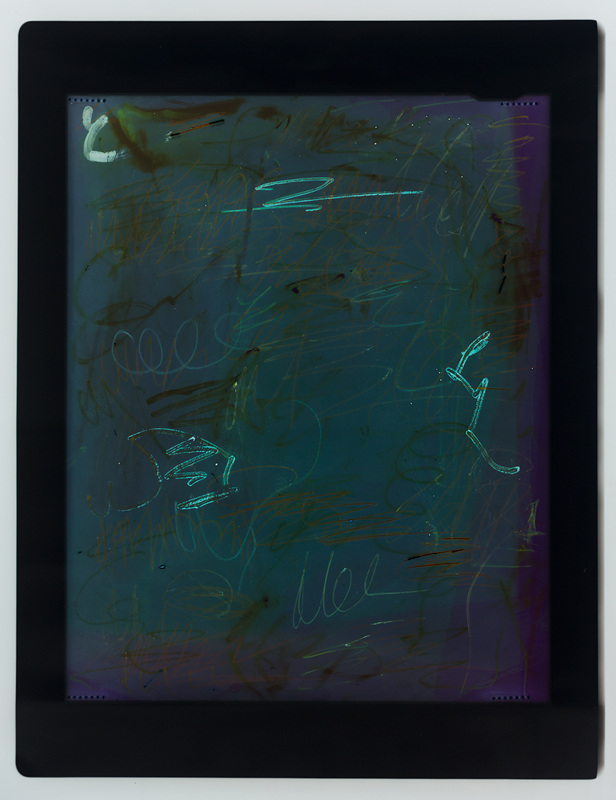
The work was controversial, partly because it is not a traditional, figurative portrait. Partly because instead of taking a tradional picture of her grandmother, Varga instead asked her grandmother to draw and spit on a a piece of photgraphic film, which she then printed to create the finsished work. And finally becuse some people questioned whether the work was created by Varga, in which case she would be eligible to win the prize, or by her grandmother, in which case the work could not be Varga’s and so would be ineligible.
In a way this image was the perfect winner of the prize as it provoked a reaction and debate, much of it seemingly ill informed, and therefore engaged an audience with the image. In a defence of his decsion to select the image published in The Guardian in 2017, judge Shaune Lakin put forward and eloquent defence of his decision to select the work. Lakin stated:
All the same, “photographic portraiture” is a wonderfully broad term and not one limited to what goes on in photographic studios, photojournalism, documentary photography or, for that matter, on Facebook. It is a term perfectly suited to Varga’s photograph: it’s a portrait of her grandmother made using photographic processes.
Shaune Lakin, The Guardian 2nd August 2017
As an image I like the colours and do not mind the markings, I understand the idea that the they are as valid an indication of the presence of a person as the objects I photographed for exercise 5.1, Still Life. Varga herself wrote very movingly about this in an essay published on the website, photomonitor:
When she is no longer of this world I will still always have her with me. If you close your eyes and imagine a loved one, I can almost guarantee that the impression you will find won’t be crisp and clear; it will be muffled and somewhat muted, just a memory of a gesture or the sound of a laugh; yet somehow you know it is them. My photography seeks to evoke this kind of sensation.
Justine Varga, Photomonitor
Initially I was sceptical about the image and its whether or not it could be considered as a portrait but after reading more about how it was created and the artist’s thinking I have come to the view that it is a a non-figurative portrait in the same vein as others that have been presented in this section of the course. To me it really does challenge the nature of what a portrait can be and illustrates that a rejection of work of this kind is often due a failure of imagination. As a photography student this image has made me think about what I consider a photograph to be, and how constrained and traditional my thinking about photography is. It also made me think about whether I want to change this and if so, am I capable of doing so? Lots to think about.
Sources
Taylor, A. (2017) Olive Cotton Award: Is it a photo?. [Newspaper] At: https://www.smh.com.au/national/nsw/olive-cotton-award-is-it-a-photo-is-it-a-portrait-should-justine-vargas-grandmother-be-given-the-prizemoney-20170726-gxj8n5.html (Accessed 11/06/2020).
Lakin, S. (2017) Why I chose the ‘spit and scribble’ photograph. [Newspaper] At: https://www.theguardian.com/artanddesign/2017/aug/02/why-i-chose-the-spit-and-scribble-photograph-olive-cotton-judge-on-the-global-furore (Accessed 12/06/2020).
Varga, J. (2017) Maternal Line. At: https://www.photomonitor.co.uk/maternal-line/ (Accessed 12/06/2020).
 OCA517401I&P