Francesca Woodman was an American photographer born in Denver, Colarado in 1958 and who died in New York on the 19th January 1981. Born into a family of artists, George Woodman, a painter and photographer who taught at the University of Colarado; and Betty Woodman who worked in ceramics, Woodman first started taking pictures at a young age and her interest in photography developed whilst attending Abbott Academy, a private boarding schoool in Massachusetts. Whilst at Abbot Academy she attended photography classes and was guided by one of her teachers, Wendy Snyder McNeil. It was while attending Abbott Academy that she took her first self-portrait in 1973, at the age of thirteen, whilst staying at the family’s house in Antella near Florence.
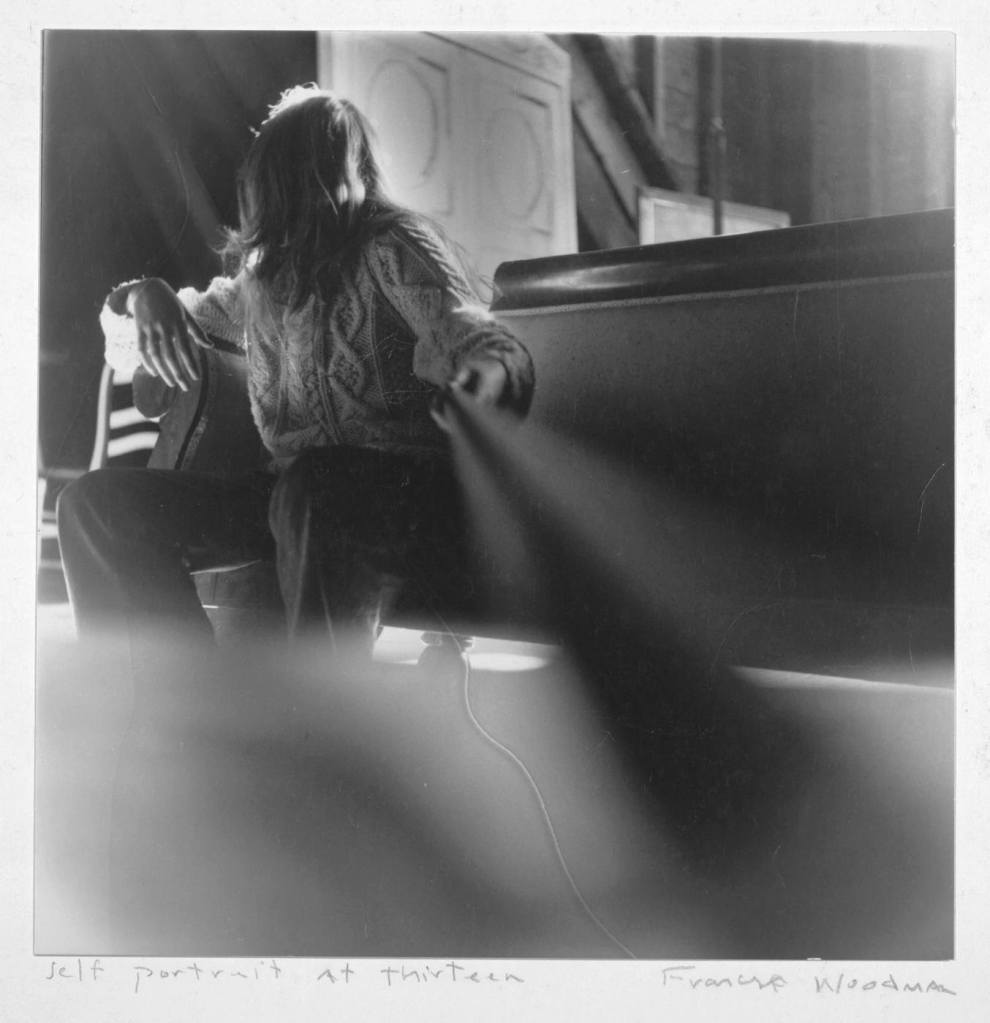
The portrait shows Woodman with her head turned away from the camera, her face covered by her hair and an out of focus area, part of which appears to be a rod she may be using to open the shutter, although there also appears to be a cable for a cable release, either way it denotes Woodman as the author of the work. The blurred area and the disjointed background elements are themes that reoccur in Woodman’s work and by not engaging withthe camera Woodman is both present and absent, another theme that she would return to in her subsequent self-portraits.

In the above image from 1976, Woodman is seen naked imersed in water and entwined in tree roots whilst in the background is what appears to be a cemetry with headstones. The work, with Woodman in the light foreground, and the cemetery in the darker background encompasses life and death, with Woodman’s emergence from the roots of the tree a signifier of birth. As Woodman seldom titled her work, ususally just stating the location and year, it is up to the viewer to decipher from the visual clues the narrative of the image.

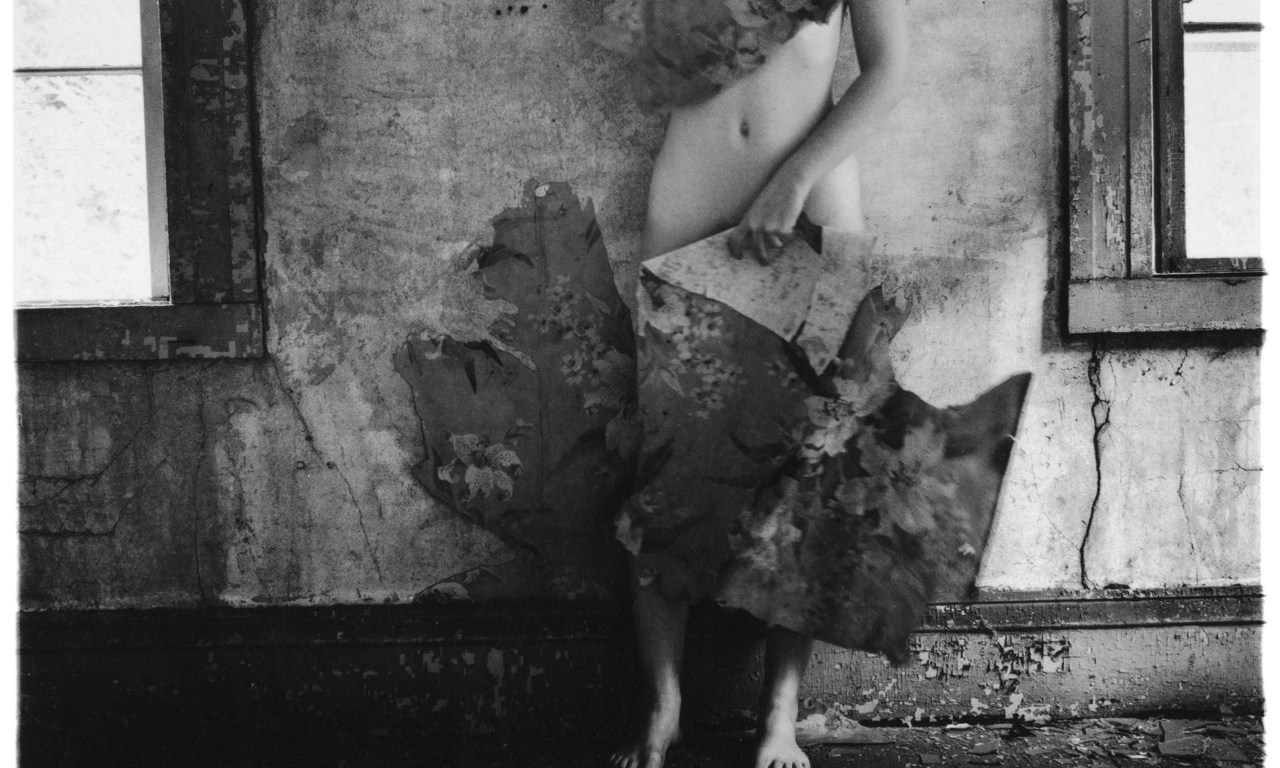
In the same year shot the above image from a series title Space. In Space2 Woodman is standing naked between two windows, her body partially obscured by pieces of discarded wallpaper. In the image Woodman is disappearing into the dilapidated building, and the image seems to be posing questions about presence and absence, existence and non-existence and asking the fundamental question, who am I?
Later work by Woodman seemed to move on from the idea of presence and absence and questions about identity and seemed to be more reflective of her faltering mental health.
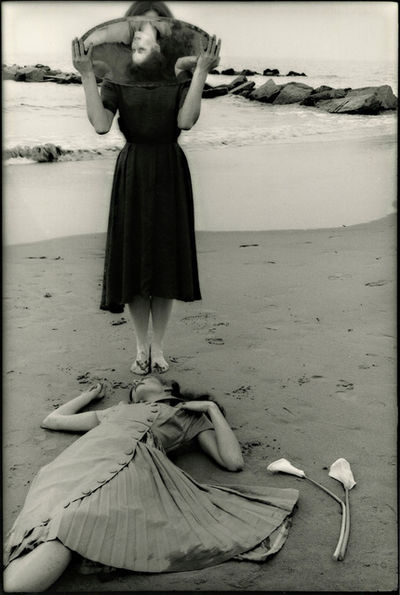
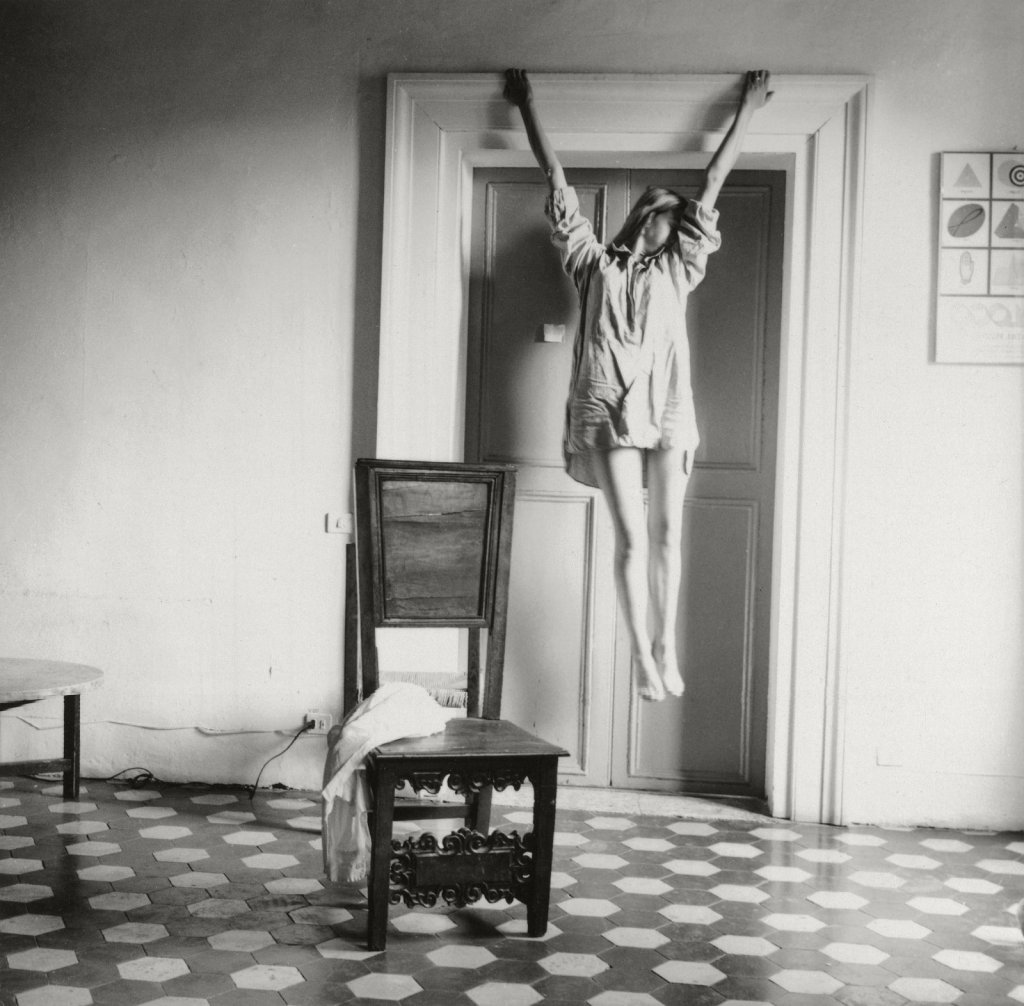
The above image appears to show Woodman’s funeral with Woodman lying next to a couple of lillies, a mourner dressed in black and Woodman herself looking down on the scene from above, a reference to heaven? And in the image below from the series On Being an Angel, Woodman’s pose is reminiscent of Christ on the cross or possibly given the chair close by the pose could signify suicide.
The problem with Woodman’s work is that it tends to be viewed through the prism of her suicide and because she did not live to explain the meanings behind her work it is easy for them to be interpreted as pointers to her menatl health. In an article in the Guardian in 2014 titled Searching for the real Francesca Woodman, Rachel Cooke interviewed Woodman’s parents who tried to present a picture of the daughter they knew and not the tortured talent who killed herself at the age of 22.
What I like about Woodman’s images is the the thoughtfulness of their composition and contrast. I think that their ambiguity is part of their appeal, resutling in the viewer engaging with the images in a more in depth way than more conventional self-portraits.
Sources
Woodman, F., n.d. Francesca Woodman Artworks & Famous Photography. [online] The Art Story. Available at: <https://www.theartstory.org/artist/woodman-francesca/artworks/> [Accessed 3 May 2020].
https://en.wikipedia.org/wiEn.wikipedia.org. 2020. Francesca Woodman. [online] Available at: <https://en.wikipedia.org/wiki/Francesca_Woodman> [Accessed 3 May 2020].
Cooke, R., 2014. Searching For The Real Francesca Woodman. [online] the Guardian. Available at: <https://www.theguardian.com/artanddesign/2014/aug/31/searching-for-the-real-francesca-woodman> [Accessed 3 May 2020].
Gumport, E., 2011. The Long Exposure Of Francesca Woodman. [online] The New York Review of Books. Available at: <https://www.nybooks.com/daily/2011/01/24/long-exposure-francesca-woodman/> [Accessed 3 May 2020].
 OCA517401I&P