Robert Mapplethorpe (1946 – 1989) was and American photographer born in Floral Park, Queens, New York. In 1963 he enrolled at the Pratt Institute in Brooklyn where he studied drawing, painting and sculpture. Mapplethorpe started taking photographs after acquiring a Polariod camera in 1970 and in 1973 the Light Gallery in New York mounted his first solo exhibition, Polaroids.
Although best known for his male and female nudes, flower studies and controversial images of the underground S&M scene in New York; Mapplethorpe also took self-portraits from early in his photographic career until shortly before his death in 1989.
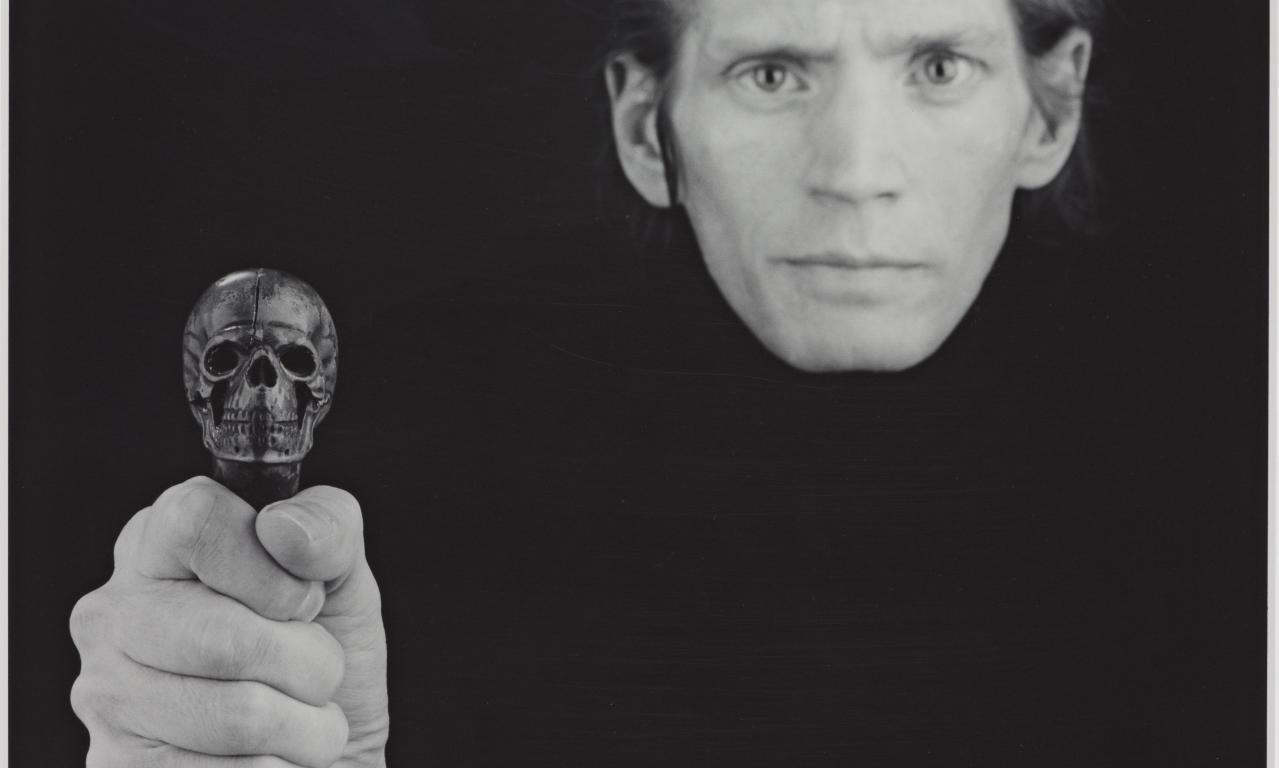
I want to look at two of his self-portraits, one from 1980 and the other from 1988.
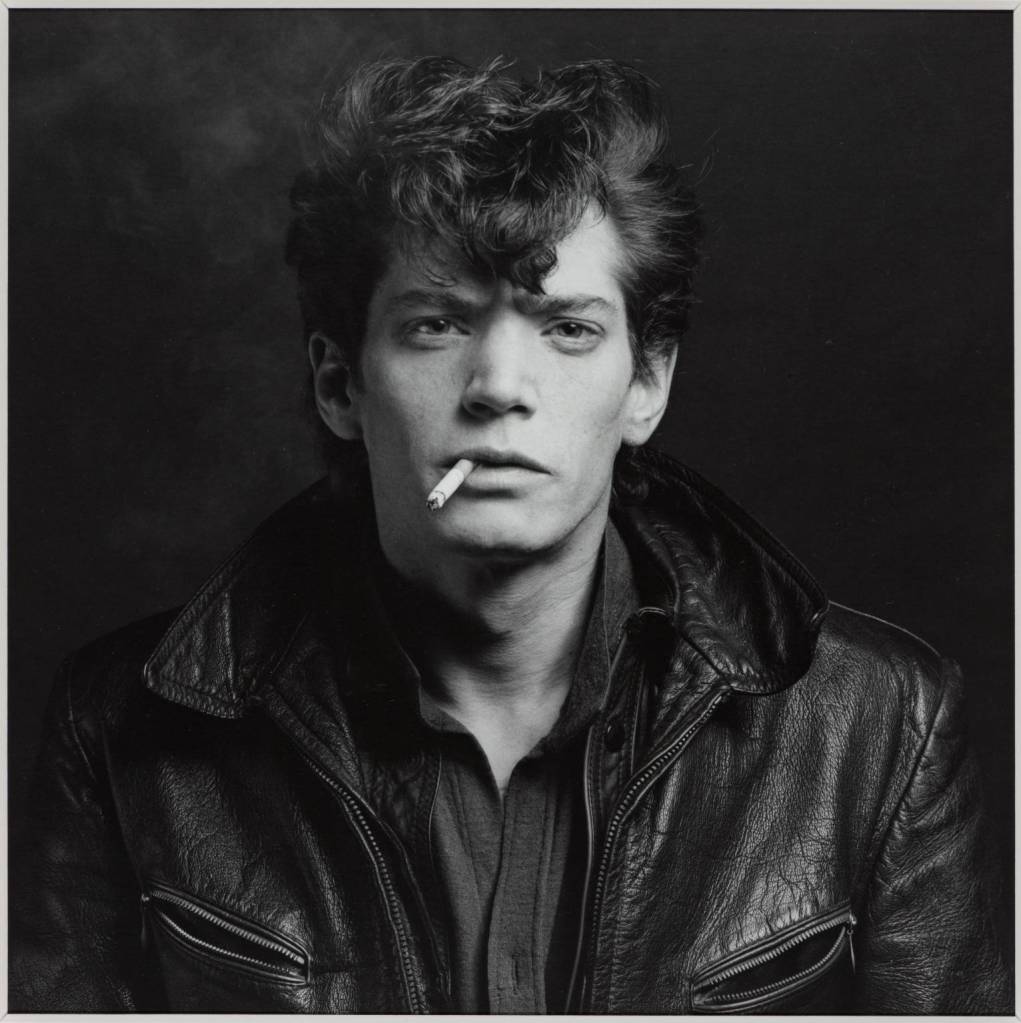
In the above image Mapplethorpe has chosen to portray himself as an archetypal ‘bad boy’. The image is reminiscent of James Dean, the cultural icon of teenage disillusionment and social estrangement, with the cigarette hanging from his the corner of his mouth, the black leather jacket and the carefully coiffed 1950s style hair. In this image Mapplethorpe is portraying himself as cool, unemotional, detached.

Taken just eight years late, the above portrait is anything but detached, but is instead an image that recognises and confronts Mapplethorpe’s mortality. Mapplethorpe was diagnosed with AIDS in 1986 and at the time the life expectancy of of AIDS sufferers was around two years. The image is a contemplation of death and uses several signifiers to convey this message. The cane featuring a skull which Mapplethorpe is holding is the only element in the image that is sharp; bringing death into focus. Mapplethorple himself is surrounded by black, the colour of death, which signifes not only Mapplethorpe’s prognosis, but also the the prevalence of death in the gay community at th time. As the image was shot with a shallow depth of field, Mappethorpe’s face is slightly out of focus, possibly signifying his fading away.
I think it is interesting how Mapplethorpe used signifiers in his self-portraits to communicate to the viewer. Whilst these images do not have any direct bearing on my concept for assignment three, I think they do serve as a useful reminder of the use of signifers to enable and image to tell a story.
Sources
Mapplethorpe.org. n.d. The Robert Mapplethorpe Foundation – Biography. [online] Available at: <http://www.mapplethorpe.org/biography/> [Accessed 25 April 2020].
En.wikipedia.org. 2020. Robert Mapplethorpe. [online] Available at: <https://en.wikipedia.org/wiki/Robert_Mapplethorpe> [Accessed 25 April 2020].
Tate. n.d. Robert Mapplethorpe: Self Portraiture: Identity And Mortality | Tate. [online] Available at: <https://www.tate.org.uk/artist-rooms/learning/resources/robert-mapplethorpe-broken/robert-mapplethorpe-self-portraiture> [Accessed 25 April 2020].
 OCA517401I&P