
Keith Arnatt (1930 – 2008) was a British conceptual artist who stuied at the Oxford School of Art and later at the Royal Academy Schools in London. In the late 1960s/early 1970s Arnatt produced several conceptual self-portraits.
In 1968 Arnatt produced Invisible Hole Revealed by the Shadow of the Artist.
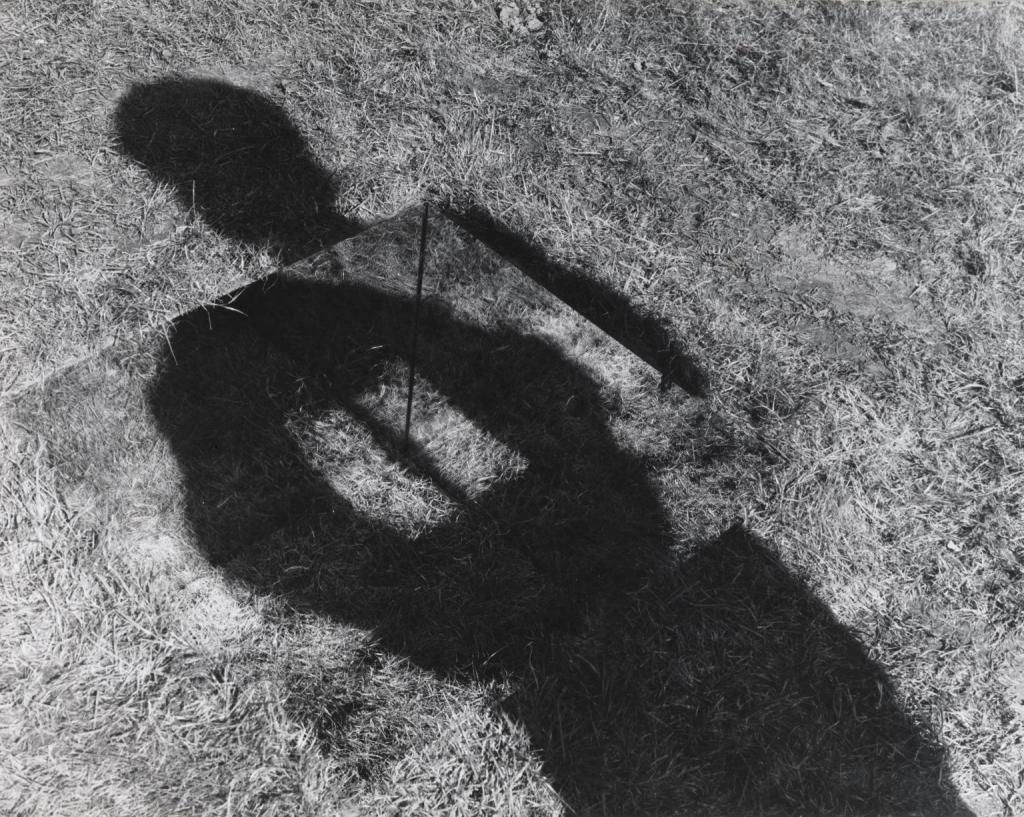
Although notionally a self-portrait, what Arnatt was exploring was the veracity of photography as a medium. Quoted in John Roberts, The Impossible Document: Photography and Conceptual Art in Britain 1966–1976, Arnatt stated ‘I was beginning to become aware of the unreliability of photographic evidence and began to play with that feature. I felt that what a photograph could not tell or show might be just as significant as what it could’ (Roberts, 1997).
The following year, Arnatt produced his first photographic performance project for the German television station Westdeutsches Fernsehen. Originally called Disappearance of the artist, in October 1969 over a period of nine days each of the images was broadcast for about two seconds, sometimes interrupting peak viewing, with no explanation leaving viewers to make sense of them as best they could. The work was a comic expression of critical debate at the time; the dematerialisation of the art object.
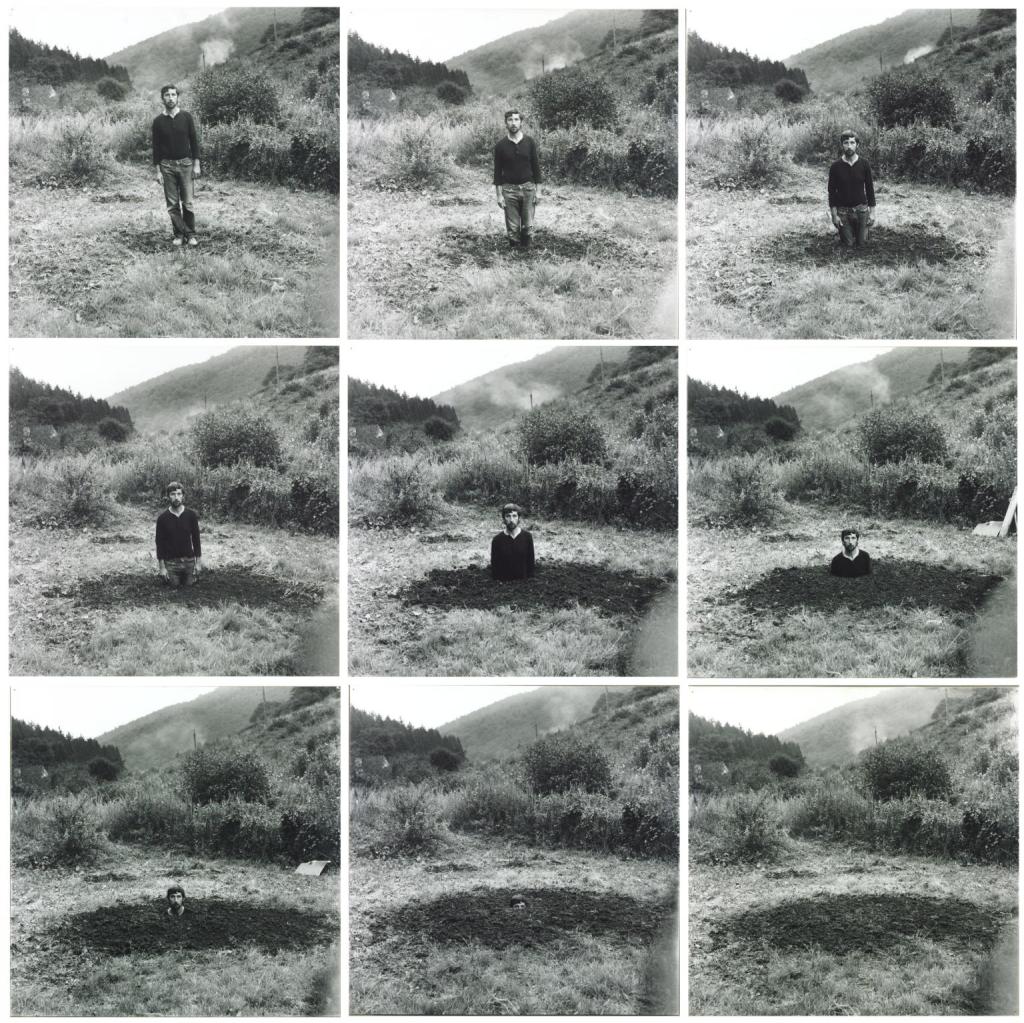
Writing about the work in 2004 Liz Wells stated:
In conceptual photography the characteristics of the medium could be used as a part of the means of the expression of an idea. Thus, for instance, Keith Arnatt’s sequence of digging himself into a hole in the ground is obviously, at one level, a metaphoric reference to the well-known phrase. But the docuementary idiom secures a sense that this event literally did take place through demonstrating the sequence of moments in time.
Liz Wells, 2004
In 1969 Arnatt also produced his work Portrait Of The Artist As A Shadow Of His Former Self.

Once again Arnatt used a self-portrait to poke fun at avant-garde art at the time which incorporated the image of the artist as subject, object and creator of the work, again within the context of disappearance.
Although Arnatt’s work is not something that I think I will use as inspriation for assignment three, I like the way he used self-portraits to pose questions about issues other than the person.
Sources
Tate. n.d. ‘Portrait Of The Artist As A Shadow Of His Former Self’, Keith Arnatt, 1969–72, Printed 2000 | Tate. [online] Available at: <https://www.tate.org.uk/art/artworks/arnatt-portrait-of-the-artist-as-a-shadow-of-his-former-self-t07647> [Accessed 24 April 2020].
En.wikipedia.org. 2019. Keith Arnatt. [online] Available at: <https://en.wikipedia.org/wiki/Keith_Arnatt> [Accessed 24 April 2020].
Wells, L., 2004. Photography. London: Routledge, p.274.
Roberts, J., 1997. The Impossible Document. London: Camerawork, p.47.
Tate. n.d. ‘Invisible Hole Revealed By The Shadow Of The Artist’, Keith Arnatt, 1968 | Tate. [online] Available at: <https://www.tate.org.uk/art/artworks/arnatt-invisible-hole-revealed-by-the-shadow-of-the-artist-p13145> [Accessed 24 April 2020].
Tate. n.d. ‘Self-Burial (Television Interference Project)’, Keith Arnatt, 1969 | Tate. [online] Available at: <https://www.tate.org.uk/art/artworks/arnatt-self-burial-television-interference-project-t01747> [Accessed 24 April 2020].
 OCA517401I&P