
For this exercise we are asked to present a series of five images that illustrate examples of the gazes mentioned in the course folder.
The definitions that feature in the course notes are set out below:
- the spectator’s gaze – the look of the viewer at a person in the image.
- the internal gaze – the gaze of one depicted person at another within the same image.
- the direct address – the gaze of a person depicted in the image lookin out directly, as if at the viewer (through the camera lens).
- the look of the camera – the way the camera itself appears to look at people depicted in the image (the gaze of the photographer).
- the bystander’s gaze – the viewer being observed in the act of viewing.
- the averted gaze – the subject in the image deliberately looking away from the lens.
- the audience gaze – an image depicting the audience watching the subject within the image.
- the editorial gaze – the whole ‘institutional’ process by which a proportion of the photographer’s gaze is chosen and emphasised.
Because of the coronavirus restrictions I have used photographs from my archive that demonstrate some of the gazes mentioned above.
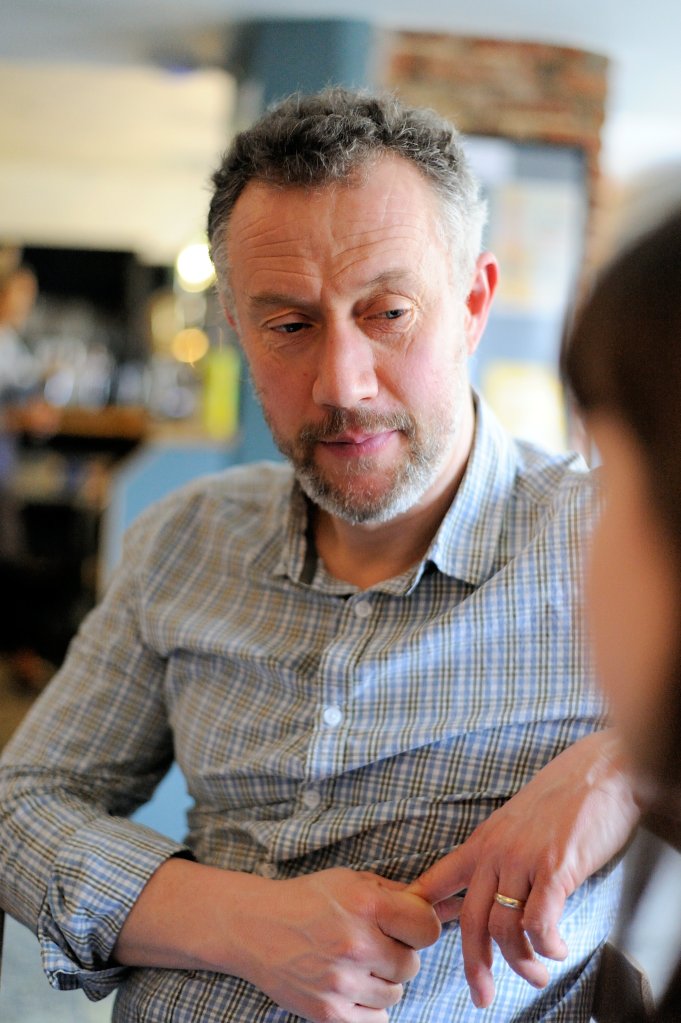
In this image my brother is looking at someone within the image who we cannot clearly see. The fact that there is only a small part of the person’s head visible and that it is out of focus leaves the viewer to speculate as to the relationship and the dynamic between them.

This was an image I took whilst working on exercise 2.2, covert. I was initially not entirely sure that the man in the red jacket is looking directly into the camera on purpose, but having viewed the image at full size I am confident that he is. I like the fact that it is difficult to know what the man is thinking from his look. Is he surprised, disapproving, wary; it is difficult to say?

This photograph is one of a series I took of my niece. When viewed with the other images it is clear that she averted her gaze and no longer wanted to be photographed.
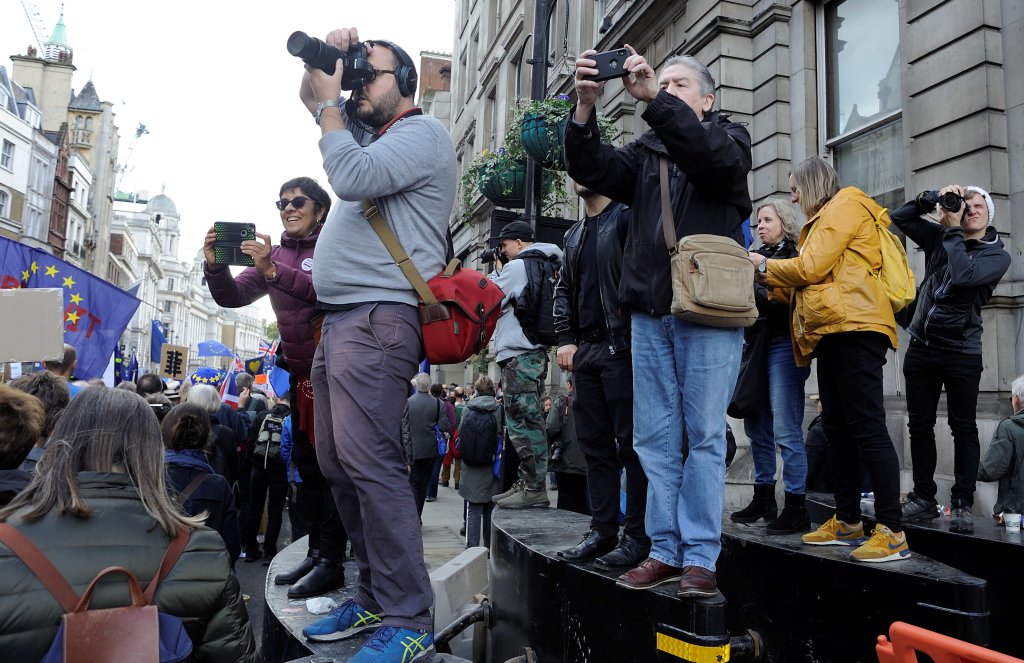
I am not really sure that this image really high-lights the photographer’s gaze but it is the best one I could find showing photographers.

The small audience looking at and cheering on the runners. Thinking about the term it seems inappropriate; surely it should be the spectators’ gaze as the sujects will be looking at an event, not listening to it?
I hadn’t really considered the gaze as a subject before reading the notes in the course folder. I found some of the definitions in the course folder slightly unclear and I’m still not entirely sure what ‘the look of the camera’ and ‘the editorial gaze’ are. I looked up the terms online and did not find much more information or other definitions that would help clarify these terms, however, I did find that the subject of the gaze is far more complicated and political than I had imagined.
One term that came in a lot of search results was ‘the male gaze’, a concept advanced by Laura Mulvey in her 1975 essay Visual Pleasures and Narative Cinema. In the essay Mulvey puts forward her idea that sexual inequality, the asymmetry of social and political power between men and women, is a controlling social force in the cinematic representations of the sexes. The idea that the representation of women in cinema was, and is, unequal and demeaning can be applied to the arts more generally and particularly the visual arts. The Geurrilla Girls’ Most Wanted series that ran between 1985 and 2006 high-lighted the inequality between the sexes as shown below.
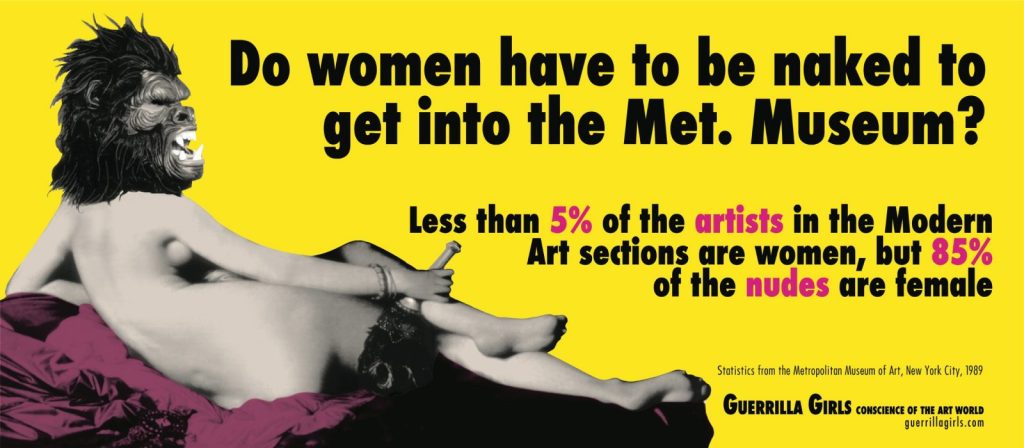
1989
Jacques Lacan was a French philospher who set out his theories on vision in a series of four seminars given in 1964. Dr. Maria Scott, Senior Lecturer in French at the University of Exeter writing on the website The DS project (www.dsproject.com) wrote ‘The four seminars are difficult, if not impossible, to make sense of’ (Scott, n.d.), however, she then goes on to break down Lacan’s seminars into four areas; the gaze as lost object, the gaze as substitute object, the gaze as cause of fascination and the gaze as cause of separation. I tried to understand Lacan’s theories but found them difficult to follow and struggled to see their relvance to the course.
Sources
Scott, M., n.d. Deciphering The Gaze In Lacan’S ‘Of The Gaze As Objet Petit | The DS Project. [online] The DS Project |. Available at: <http://thedsproject.com/portfolio/deciphering-the-gaze-in-lacans-of-the-gaze-as-objet-petit-a/> [Accessed 16 April 2020].
Cla.purdue.edu. 2011. Introduction To Jacques Lacan, Module On The Gaze. [online] Available at: <https://cla.purdue.edu/academic/english/theory/psychoanalysis/lacangaze.html> [Accessed 16 April 2020].
 OCA517401I&P