
August Sander (1876 – 1964) was a German photographer who was active in the first half of the 20th century. Whilst running his own commercial studio, Sander began taking photographs of the farmers in rural Westerwald. This led him to develop the idea of creating a set of forty-five portfolios, each containing twelve images that would collectively be called People of the 20th Century (Marien, 2014). Sander did not complete this collection, however, he did publish a book of sixty photographs in 1929 titled Antlitz der Zeit (Face of the Time) and in it the images are divided into seven categories; the farmer, the skilled tradesman, woman, classes and professions, the artists, the city and the last people (homeless and disabled people etc.).
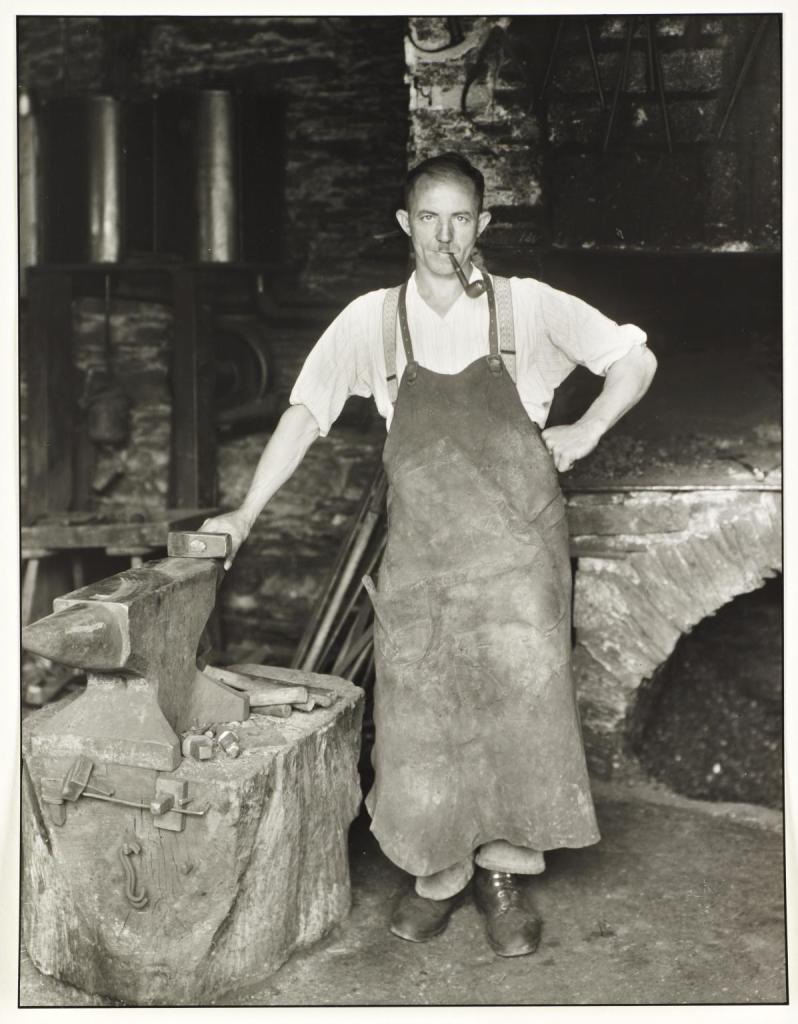
© Die Photographische Sammlung/SK Stiftung Kultur – August Sander Archiv, Cologne; DACS, London, 2019.
This above image is typical of Sander’s photographs showing people involved in manual occupations. Essentially an environmental portrait with the figure placed centrally in the frame and looking directly towards the camera. The figure is in focus and the background and foreground elements are sufficiently in focus to convey to the viewer information about the occupation of the subject. With the hammer and anvil as props in the foreground and the forge in the background it is clear to the viewer that this is a photograph of a blacksmith.
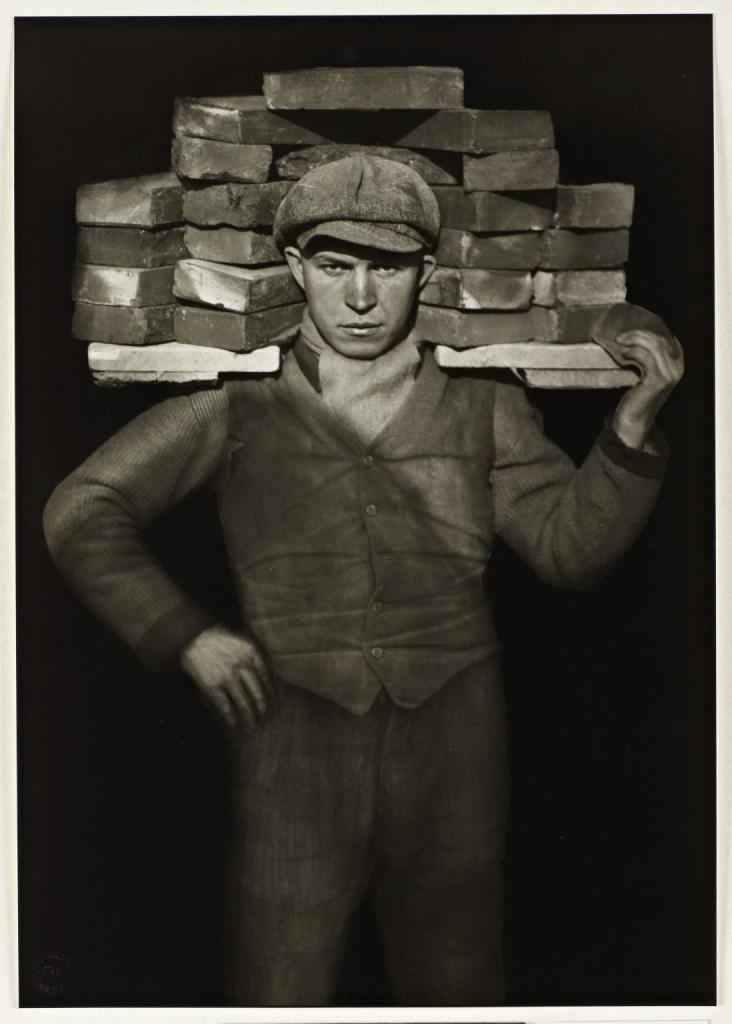
© Die Photographische Sammlung/SK Stiftung Kultur – August Sander Archiv, Cologne; DACS, London, 2019.
In this photograph Sander again places the subject in the centre of the image and looking directly at the camera, however, the black background gives no clue as to the occupation of the character,. Instead, Sander has used props, in this case bricks, to communicate that this man is a bricklayer.
Sander used the same approach when photographing artists and members of professions.
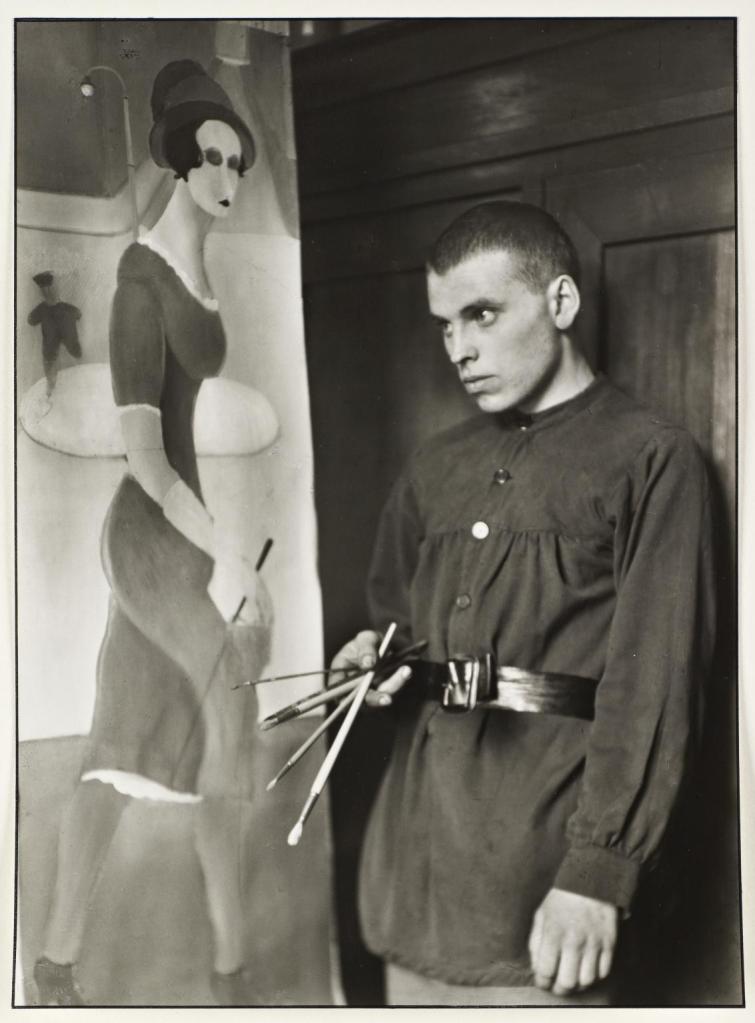
© Die Photographische Sammlung/SK Stiftung Kultur – August Sander Archiv, Cologne; DACS, London, 2019.
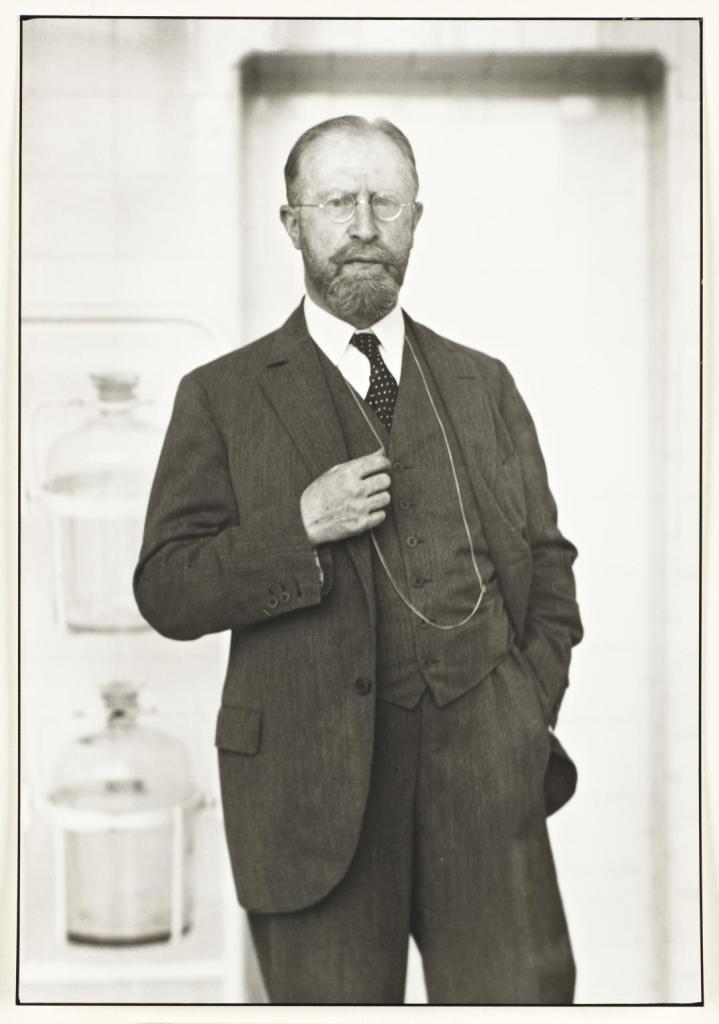
The Doctor [Carl Robert Schlayer], A. Sander, 1929
© Die Photographische Sammlung/SK Stiftung Kultur – August Sander Archiv, Cologne; DACS, London, 2019.
The 1924 photograph of the painter Gottfried Brockman uses a painting in the background, as well as brushes being held by the artist, to give context to the image and reveal information about the subject. Similarly, in the 1929 photograph The Doctor [Carl Robert Schlayer] Sander again uses objects in the background to convey information about the suited gentleman in the picture.
Looking at Sander’s images available online, they show a great variety of of subjects, poses and backgrounds. His work includes images of individuals and groups, enviromental and studio portraits, subjects sitting and standing; full length portraits, three -quarter length and head and shoulders poses. In some of his images his sitters look directly at the camera, in others they look out of frame. Despite the variety in his surviving photographs it is clear that in many of his environmental portraits Sander used the backgrounds of his images as signifiers, a way of giving the viewer additional information about his subjects. This would have been particularly important for the work he produced for Face of the Time or which was intended for People of the 20th Century, as without this contextual information signified by the backgounds and props, the placing of the images within Sander’s classifications would have been meaningless.
Sources
Marien, M. (2014). Photography. 4th ed. London: Laurence King Publishing, p.262.
En.wikipedia.org. (2019). August Sander. [online] Available at: https://en.wikipedia.org/wiki/August_Sander [Accessed 28 Dec. 2019].
Sander, A. (c1930). Blacksmith. [Photograph, gelatin silver print on paper] London and Edinburgh: Tate and National Galleries of Scotland.
Sander, A. (1928). Bricklayer. [Photograph, gelatin silver print on paper] London and Edinburgh: Tate and National Galleries of Scotland.
Sander,A. The Doctor [Carl Robert Schlayer]. [Photograph, gelatin silver print on paper] London and Edinburgh: Tate and National Galleries of Scotland.
Sander, A. (1928). Painter (Gottfried Brockman). [Photograph, gelatin silver print on paper] London and Edinburgh: Tate and National Galleries of Scotland.
Bate, D. (2016). Photography. 2nd ed. London: Bloomsbury Visual Arts, p.62-3.
Jeffrey, I. (1981) Photogrpahy. 1st Ed. New York: Oxford University Press, p. 130-5
 OCA517401I&P