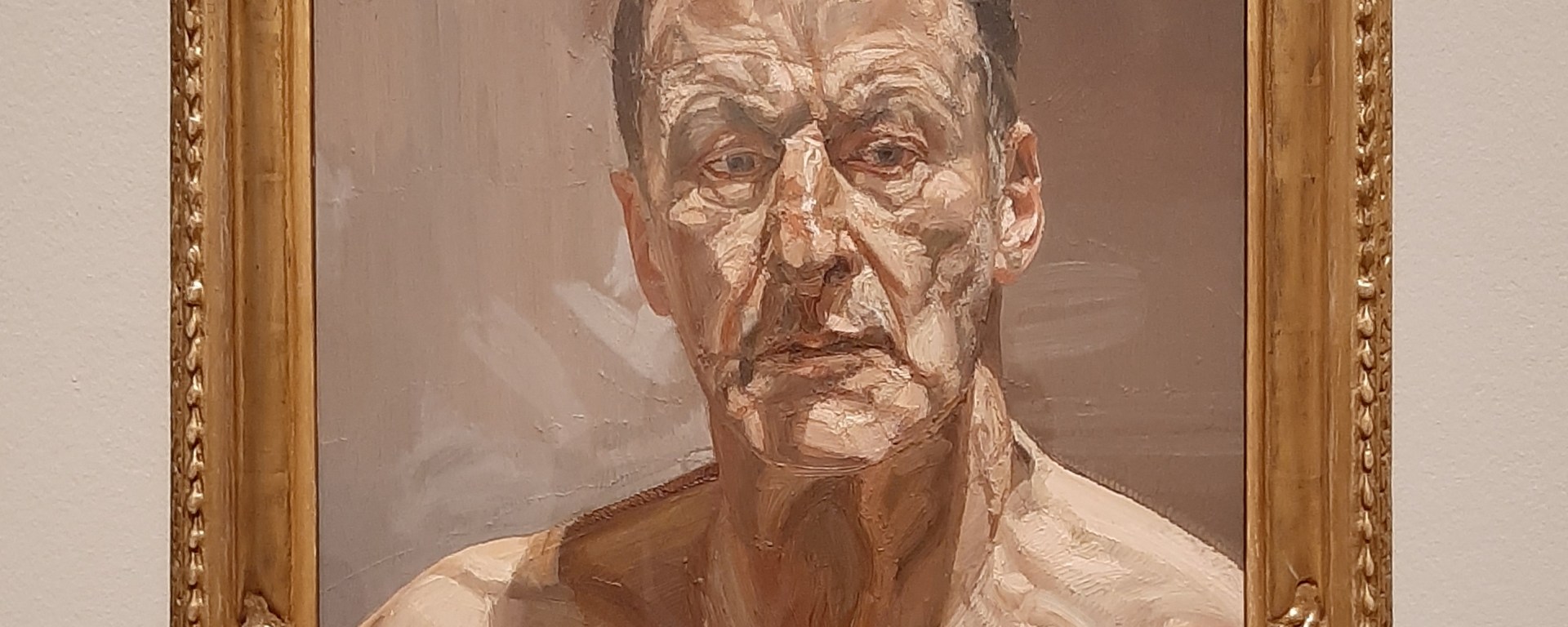
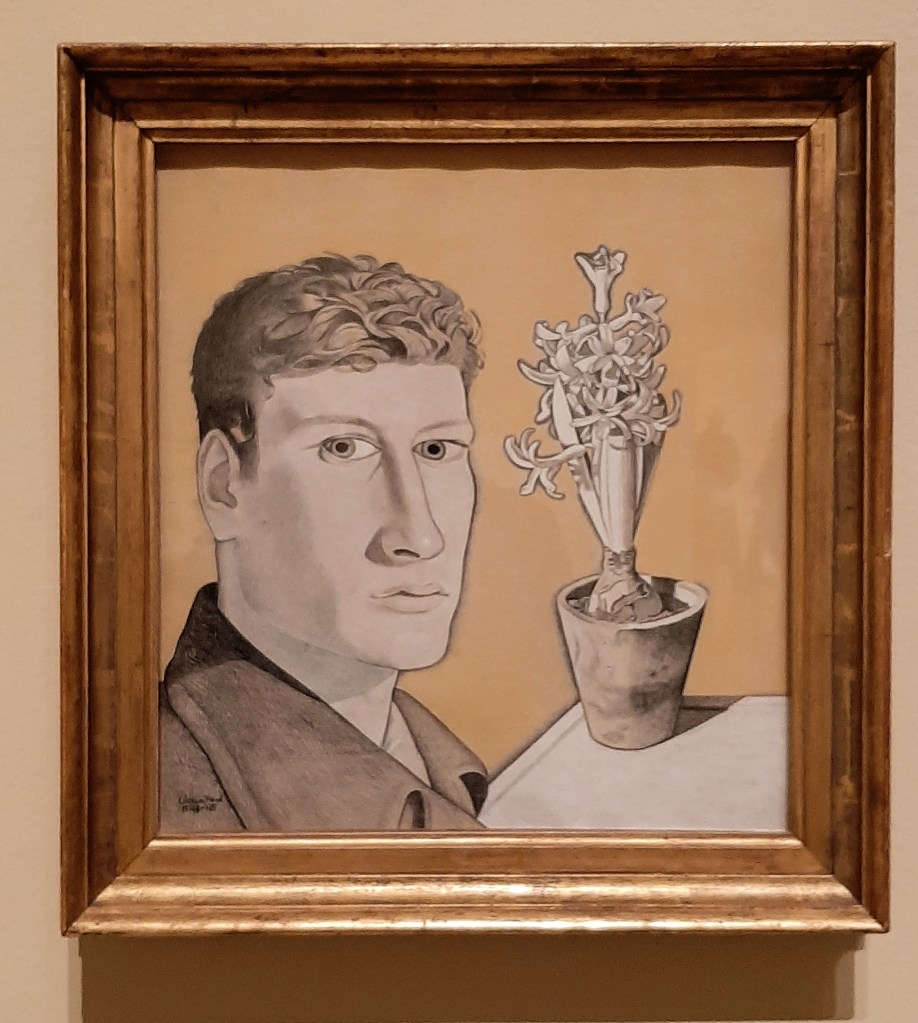
This exhibition was a comprehensive exploration of Lucien Freud’s self-portraits from early sketches produced in the 1940s to his 1993 work, Painter Working, Reflection. The exhibition was divided into five sections, the first being Drawing, which looked at his early self-portraits covering the period from around 1940 to 1949. Over this period his work demonstrated a preoccupation with line and became increasingly detailed in nature.
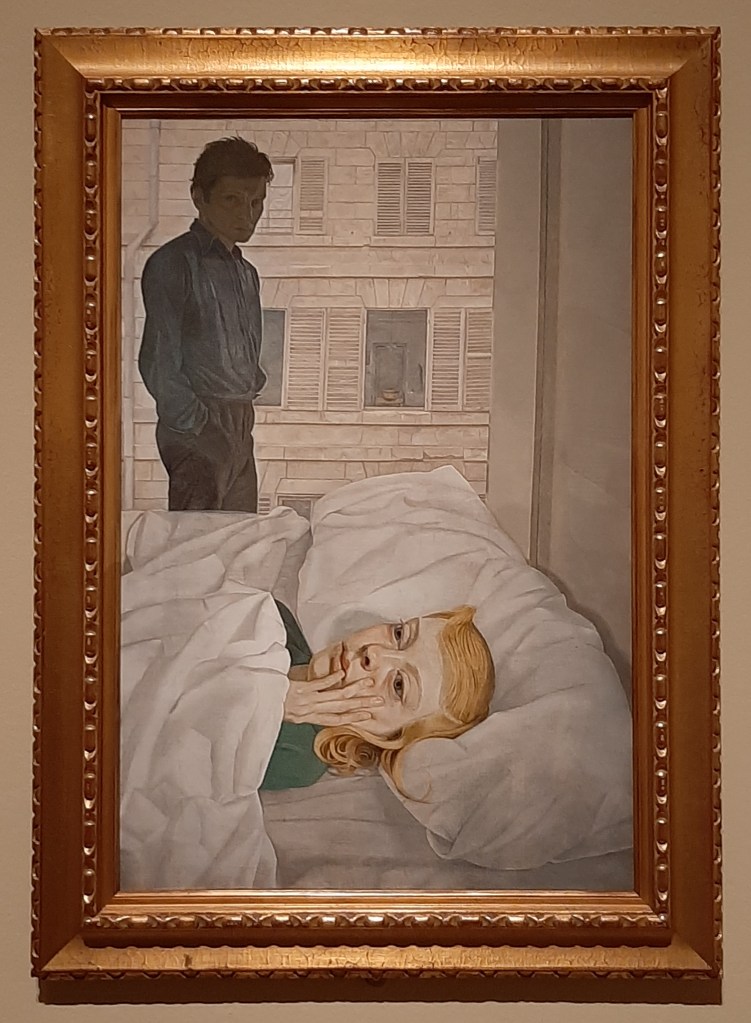
The second period, titled Transition, presented work from the mid-1950s to the early 1960s reflecting Freud’s move from drawing to painting. At the beginning of this period Freud’s work had a narrative quality to it, an example being Hotel Bedroom, 1954 which is a commentary on the state of his marriage; the empty room in the building behind signifying Freud’s view.
This period also shows how Freud moved away from narrative to realism with three images painted in 1963. The images which are painted against plain backgrounds concentrate on structure rather than likeness but are still unmistakably of Freud.
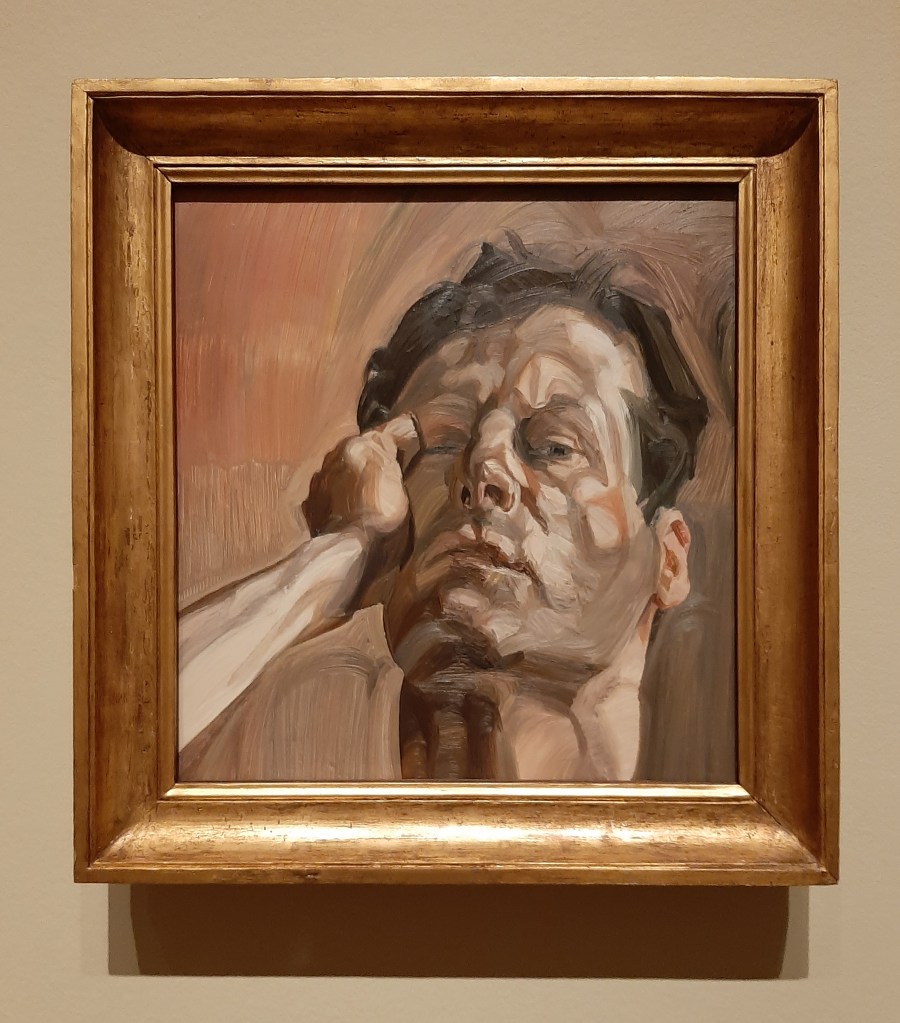
The third section, Mirrors, looked at Freud’s use of mirrors to paint his self-portraits, rather than painting from a photograph. It starts with a quote from Freud…
With self-portraits”likeness” becomes a different thing, because in ordinary portraits you try to paint the person in front of you, whereas in self-portraits you’ve got to paint yourself as another person… I have to do what I feel without being an expressionist.
Lucien Freud
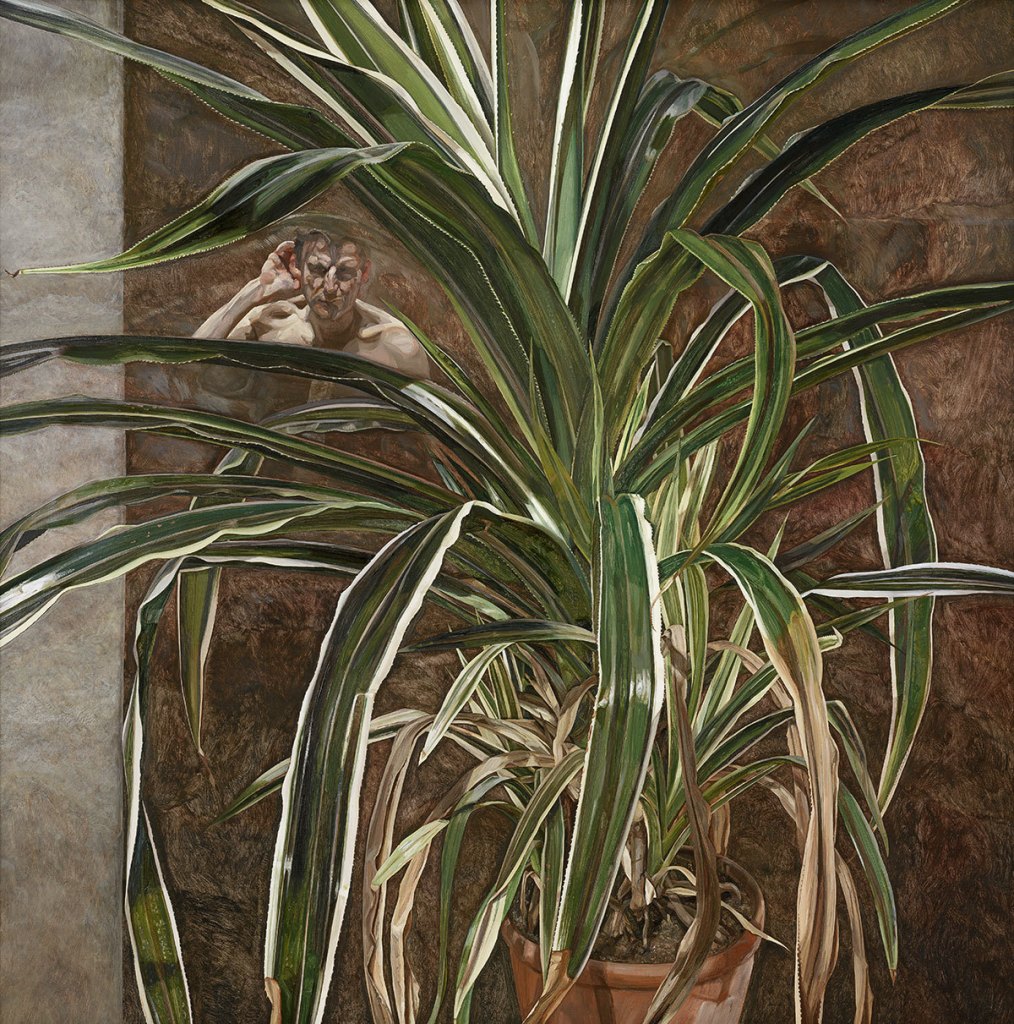
© The Lucian Freud Archive / Bridgeman Images.
The exhibition guide states…
Throughout his life, he sought to capture the physical presence of his sitters, what he termed ‘biological truth-telling’, through prolonged observation. He used mirrors for his self-prtraits to similar effect: as a practical means of seeing himself from unexpected angles, but also of painting himself at one remove, with a degree of objectivity.
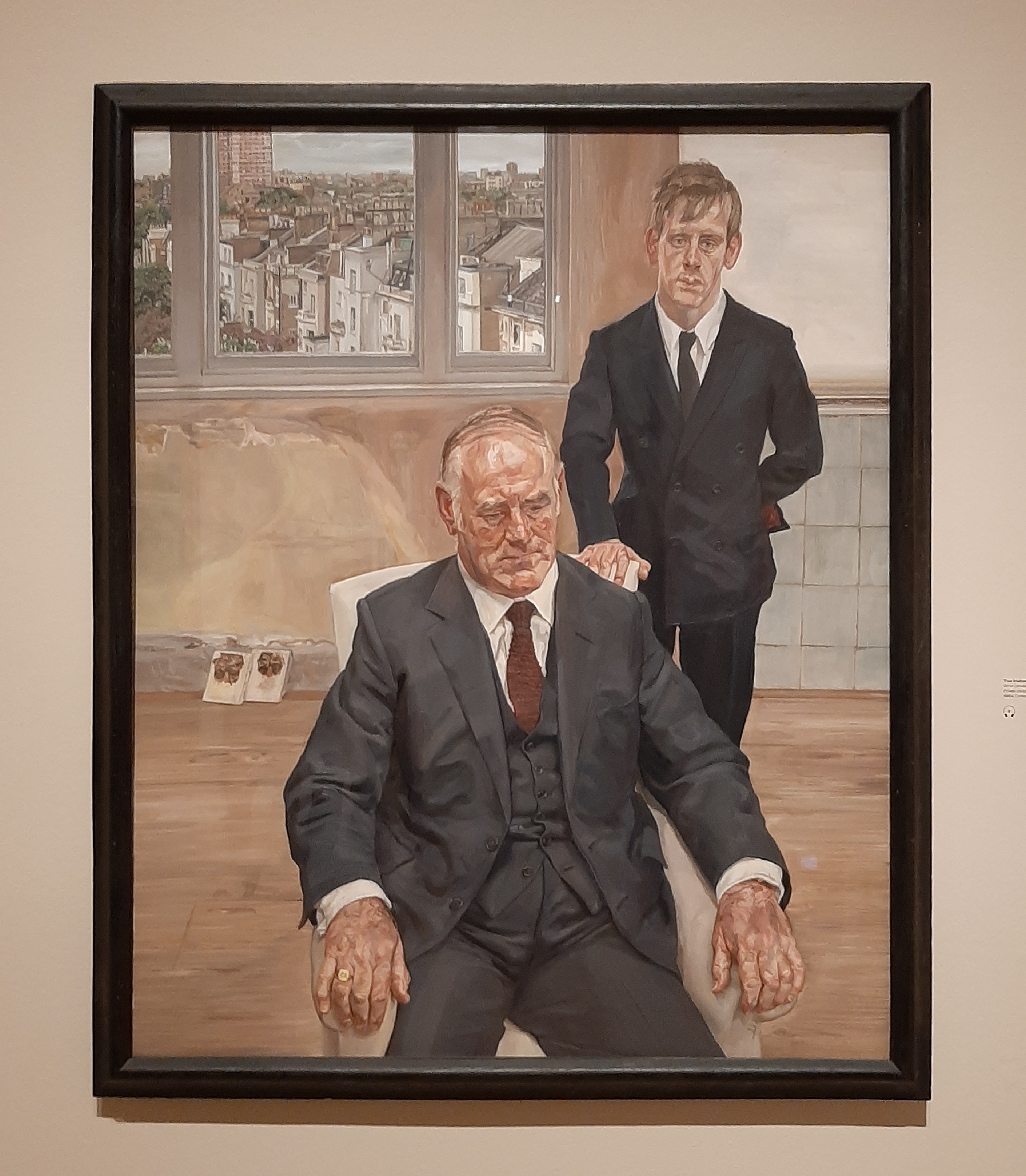
The next section, Reflections in the Studio, looked at how Freud incorporated self-portraits into portraits of other sitters and in particular how his work evolved after he started using Cremnitz White, a heavy paint that gives a granular, luminous texture when mixed with other colours. Although this section included some of his full length nudes that he started painting in the mid-1960s the example I have chosen is titled Two Irish Men, W11, 1984-85 and is a portrait of Freud’s bookmaker and his son. Freud inserts himself into the image through the two self-portraits propped up against the wall behind the sitters.
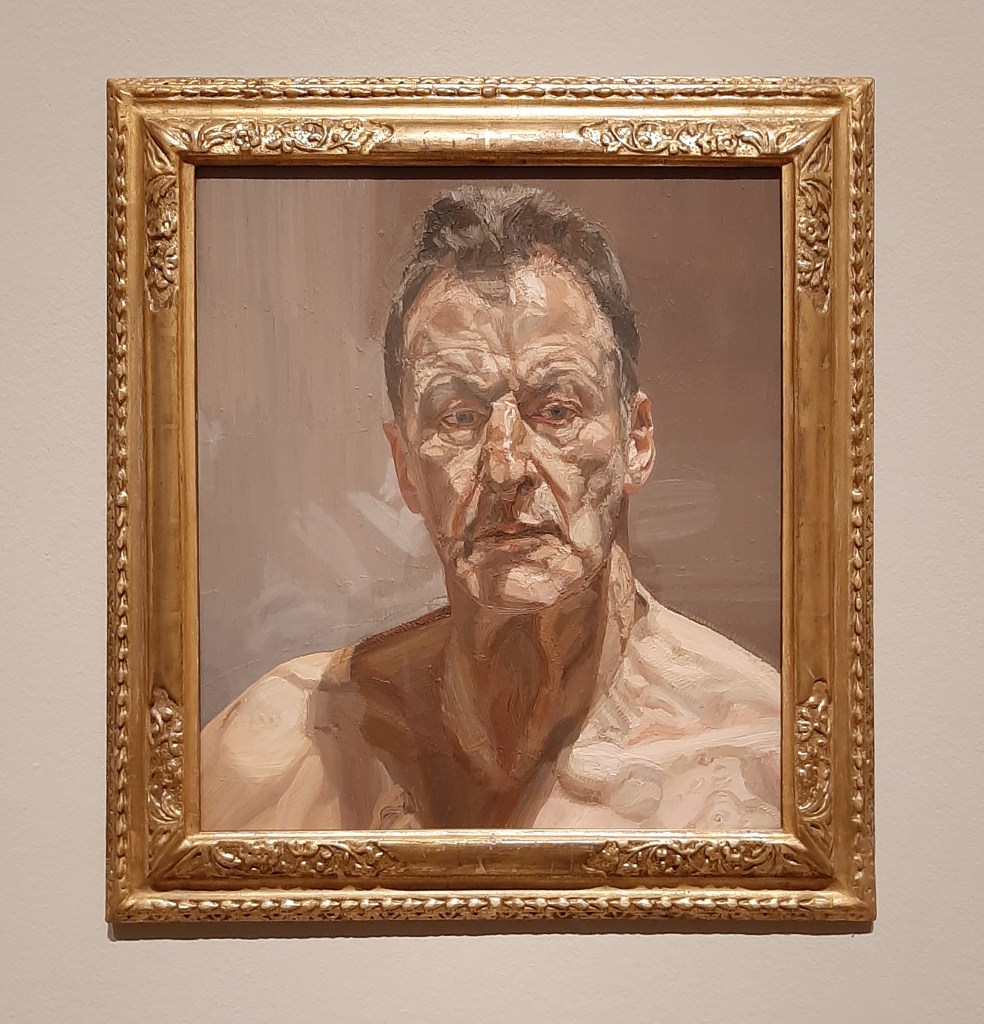
The final section, Painting at Work, contained work from the mid-1980s onwards. Freud’s portraits from this period became increasingly built up in layers possibly responding to changes in his physical appearance, this increasing artistic confidence contrasting with his increasing physical frailty.
I thought this was a fantastic exhibition and I learned a lot about a pianter who I was aware of but knew very little about. The exhibition reminded me how important it is to see works of art first hand, not just images on a screen, and therefore to print as many of my photgraphs as possible. I’m not sure if there are any direct lessons I can use for my first assignment but I think Freud’s self-portraits have reminded me to always think about light, its quality, direction and where to place your subject when creating portraits.
 OCA517401I&P